
0of22read0 XP

Describe how to minimize bias in AI systems.
Explain the relationship between bias minimization and trustworthy AI principles as defined in NVIDIA's generative AI certification framework, referencing official exam task 5.4[^1].
- Time
- 20–25 min
- Type
- exercise
- Bloom
- Understand → Create
- XP
- 100
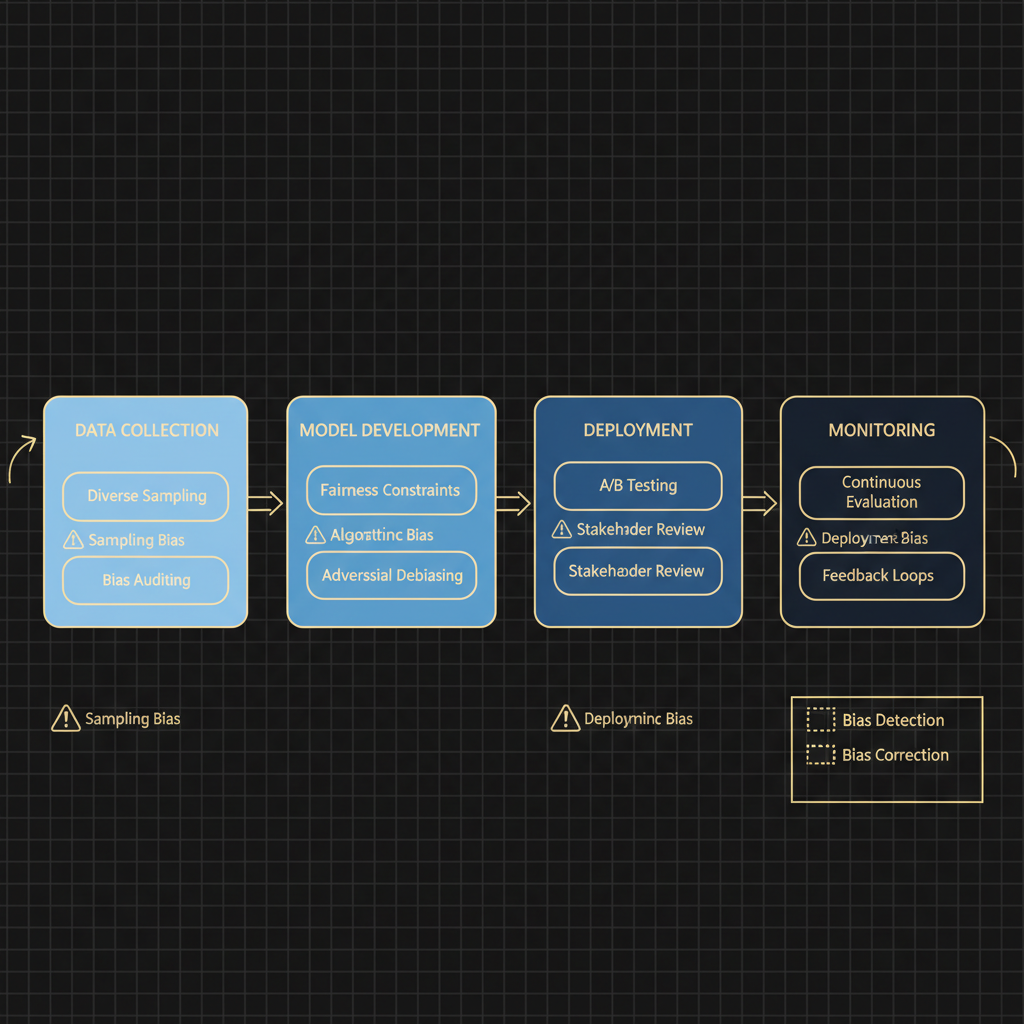
Architecture diagram for Describe how to minimize bias in AI systems.. The bias mitigation pipeline for AI systems across four sequential stages: Data Collection, Model Development, Deployment, and Monitoring. Each stage should contain 2-3 specific mitigation techniques as labeled boxes. Data Collection includes diverse sampling and bias auditing. Model Development shows fairness constraints and adversarial debiasing. Deployment displays A/B testing and stakeholder review. Monitoring contains continuous evaluation and feedback loops. Use arrows to connect stages left to right, with a feedback arrow from Monitoring back to Data Collection. Color code stages in blue gradient progression. Add small warning icons next to common bias sources (sampling bias, algorithmic bias, deployment bias) at relevant stages. Include a legend showing bias detection versus bias correction techniques using distinct border styles.
You'll be able to
- Explain the relationship between bias minimization and trustworthy AI principles as defined in NVIDIA's generative AI certification framework, referencing official exam task 5.4[^1].
- Evaluate AI system outputs for potential bias indicators by applying data analysis techniques to identify relationships, trends, and factors that could affect research results in production LLM workflows[^5][^7].
- Apply safe and effective generative AI solution practices to minimize bias during model development, drawing on NVIDIA course objectives for rapid application development with LLMs[^1].
- Create bias-mitigation strategies for LLM-based applications by integrating retrieval-augmented generation (RAG) and other trustworthy AI techniques into deployment pipelines[^1][^3].
- Classify common sources of bias in AI systems and map them to appropriate testing and validation procedures that ensure model accuracy and effectiveness in multimodal contexts[^6].
Key concepts · tap to reveal
1/22·Idea
0%
Idea
01 / 22
When Accuracy Isn't Enough
You're deploying a resume-screening chatbot when an engineer flags an anomaly: the model consistently ranks candidates with names common in certain regions lower than statistically identical profiles with different names. The system passed accuracy benchmarks, your integration is clean, and the server runs at optimal throughput. Yet buried in the model's learned patterns is a bias that could expose your organization to legal risk, reputational damage, and loss of top talent before a human ever reviews their application. The challenge isn't whether your AI works, but whether it works fairly across the populations it will affect in production.
Your task Write a prompt that asks Claude to recommend the right AI setup for a real task you're facing — then weigh its answer against this lesson, "Describe how to minimize bias in AI systems.."
a strong prompt:role · context · task · format · example
Exercise · scenario
## Scenario **Difficulty Level: Applied** You are deploying a text classification model for resume screening at a mid-sized enterprise. During validation testing, you notice the model consistently ranks resumes with names commonly associated with certain demographic groups lower than others, even when qualifications are comparable. Your manager wants to launch next week to meet a hiring deadline. The NVIDIA NCA-GENL exam objectives require you to describe how to minimize bias in AI systems [^1]. You have access to the **training data**, model weights, and a senior team member who can supervise modifications [^2]. **What would you do, and why?**
Deliverable
To demonstrate your ability to minimize bias in AI systems, produce a **Bias Mitigation Plan** as a structured Markdown document. This artifact should specify at least three concrete bias-reduction strategies applicable to a generative AI system you work with or study, grounded in the **trustworthy AI** principles NVIDIA emphasizes for safe, effective, and scalable natural data tasks [^1].
Practice · Scenarios
0 of 8 revealed
Scenario 1 of 8
An agricultural technology company builds an LLM to provide crop disease diagnosis from farmer-submitted text descriptions. The system performs excellently for large-scale industrial farms using standardized terminology but fails 60% of the time for smallholder farmers in Southeast Asia who describe symptoms using regional dialects and traditional agricultural vocabulary. The training corpus included 200,000 agronomist reports primarily from North American and European commercial operations. No linguistic diversity analysis was conducted during data collection.
Sources
- [1]NVIDIA-Certified Associate: Generative AI LLMs (NCA-GENL) Study Guide·NVIDIA-Certified Associate: Generative AI LLMs (NCA-GENL) Study Guide (2026) · Vendor
- [2]NVIDIA-Certified Associate: Generative AI Multimodal (NCA-GENM) Study Guide·NVIDIA-Certified Associate: Generative AI Multimodal (NCA-GENM) Study Guide (2026) · Vendor
- [3]OpenAlex API·OpenAlex API (2026) · Vendor
Submit your work for review
Paste your capstone artifact below. You'll get back a 4-level rubric grade, per-criterion feedback, and three concrete edits to strengthen it.