
0of18read0 XP

Awareness of the process of extracting insights from large datasets using data mining, data visualization, and similar
Apply data mining and visualization techniques to extract actionable insights from large-scale datasets in generative AI workflows, consistent with the process awareness required across multiple domains of the NVIDIA certification [^1][^2][^3].
- Time
- 20–25 min
- Type
- exercise
- Bloom
- Understand → Create
- XP
- 100
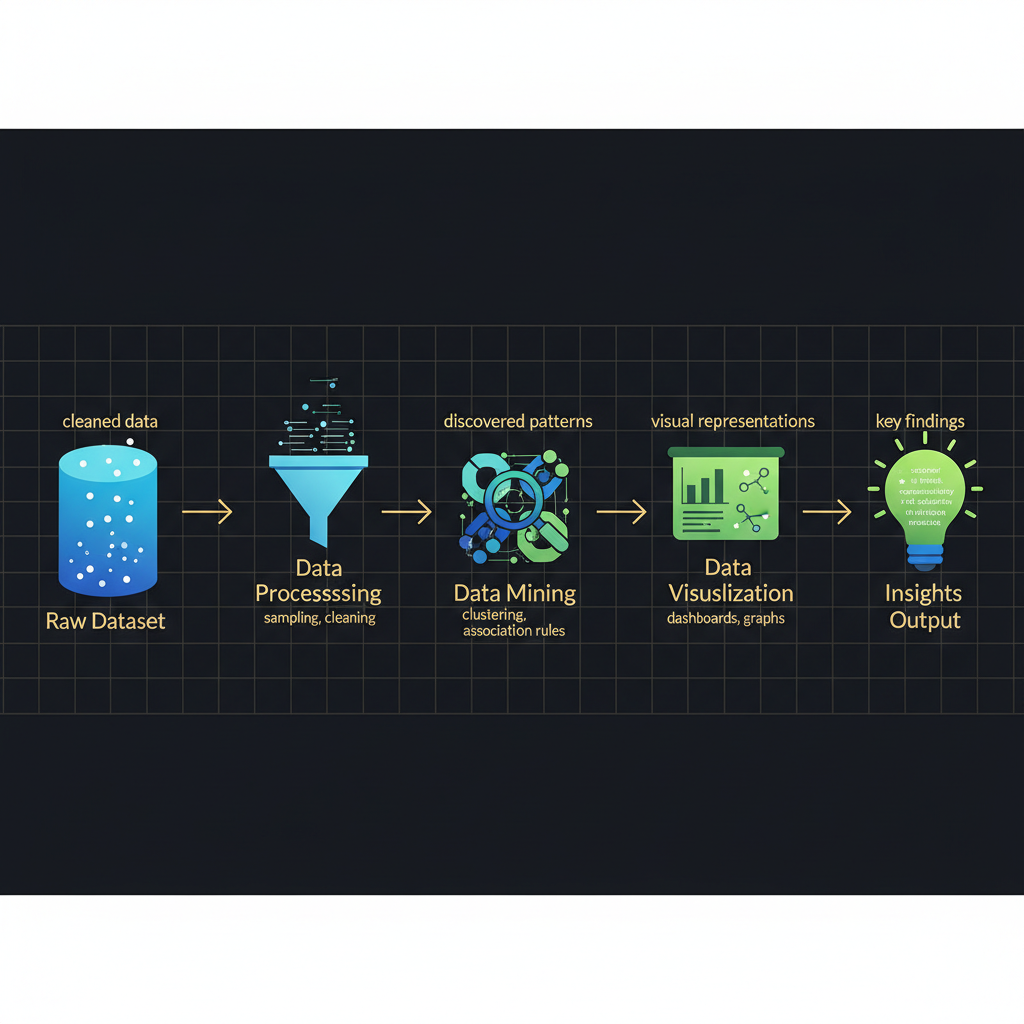
Architecture diagram for Awareness of the process of extracting insights from large datasets using data mining, data visualization, and similar. The data insight extraction pipeline with five connected stages: Raw Dataset (large cylinder icon), Data Preprocessing (filter funnel), Data Mining (magnifying glass over patterns), Data Visualization (bar chart and scatter plot icons), and Insights Output (lightbulb with key findings). Use arrows between stages labeled with intermediate outputs like "cleaned data," "discovered patterns," and "visual representations." Include small annotations showing techniques at each stage: sampling and cleaning for preprocessing, clustering and association rules for mining, dashboards and graphs for visualization. Color code stages in blues and greens to indicate progression from raw to refined information. Position sample data points flowing through the pipeline to show transformation from unstructured to actionable intelligence.
You'll be able to
- Apply data mining and visualization techniques to extract actionable insights from large-scale datasets in generative AI workflows, consistent with the process awareness required across multiple domains of the NVIDIA certification [^1][^2][^3].
- Evaluate the effectiveness of different visualization methods (such as time-series plots, recurrence plots, and wavelet transforms) for revealing patterns, anomalies, and temporal dynamics in complex datasets [^5].
- Classify the roles of data mining, visualization, and similar analytical techniques within the broader context of data analysis and experimentation tasks specified in the NVIDIA certification framework [^2][^3].
- Create visual representations of extracted insights that support mixed-initiative exploration and facilitate discovery of novel inferences across multiple dimensions of relational data [^6][^7].
- Explain how insight extraction processes integrate with visual analytics systems to support onboarding, exploration, and summarization stages of data-driven decision-making [^7].
Key concepts · tap to reveal
1/18·Idea
0%
Idea
01 / 18
When insight extraction determines success or failure
You've deployed a fine-tuned LLM that generates plausible but subtly incorrect recommendations for building energy optimization. The model runs flawlessly in testing, but in production it costs your client thousands in wasted HVAC cycles because no one visualized the training data's seasonal gaps or mined the logs for recurring anomalies before launch[^5]. The NVIDIA certification exam expects you to recognize when insight extraction, not just model tuning, determines whether your generative AI system delivers value or burns budget[^1][^3].
Your task Write a prompt that asks Claude to recommend the right AI setup for a real task you're facing — then weigh its answer against this lesson, "Awareness of the process of extracting insights from large datasets using data mining, data visualization, and similar."
a strong prompt:role · context · task · format · example
Exercise · scenario
## Scenario **Difficulty Level:** Applied You are leading a team that has just deployed a generative AI chatbot for customer support. After two weeks in production, your manager asks you to present evidence that the system is performing well. You have access to conversation logs (50,000 interactions), user satisfaction scores, escalation flags, and response-time metrics stored in a cloud data warehouse. A colleague suggests writing a summary based on spot-checking a few dozen conversations, while another recommends building dashboards that surface patterns in escalation rates, sentiment trends, and token usage over time. The exam objective emphasizes awareness of extracting insights from large datasets using **data mining** and visualization techniques [^1][^2][^3].
Deliverable
You will produce a **Data Insight Extraction Workflow Document** in Markdown format that demonstrates your awareness of the process of extracting insights from large datasets using **data mining**, **data visualization**, and similar techniques [^1][^2][^3].
Practice · Scenarios
0 of 8 revealed
Scenario 1 of 8
A pharmaceutical research lab has genomic sequencing data from 50,000 patients across 15 clinical trials, totaling 8TB. Researchers want to identify genetic markers associated with treatment response. The dataset includes mutation profiles, treatment outcomes, demographic variables, and comorbidity codes. One team member suggests using principal component analysis to reduce dimensionality. Another proposes decision tree algorithms to find predictive markers. A third recommends starting with correlation matrices and scatter plots to examine relationships between variables.
Sources
- [1]NVIDIA-Certified Associate: Generative AI LLMs (NCA-GENL) Study Guide·NVIDIA-Certified Associate: Generative AI LLMs (NCA-GENL) Study Guide (2026) · Vendor
- [2]arXiv API·arXiv API (2026) · Research
- [3]arXiv API·arXiv API (2026) · Research
- [4]OpenAlex API·OpenAlex API (2026) · Research
- [5]NVIDIA-Certified Associate: Generative AI Multimodal (NCA-GENM) Study Guide·NVIDIA-Certified Associate: Generative AI Multimodal (NCA-GENM) Study Guide (2026) · Vendor
- [6]OpenAlex API·OpenAlex API (2026) · Vendor
Submit your work for review
Paste your capstone artifact below. You'll get back a 4-level rubric grade, per-criterion feedback, and three concrete edits to strengthen it.