
0of17read0 XP

Awareness of the process of extracting insights from large datasets using data mining, data visualization, and similar
Apply data mining and visualization techniques to extract actionable insights from large-scale datasets in generative AI workflows, consistent with the exam requirement for awareness of insight extraction processes [^1][^2][^3].
- Time
- 20–25 min
- Type
- exercise
- Bloom
- Apply → Create
- XP
- 100
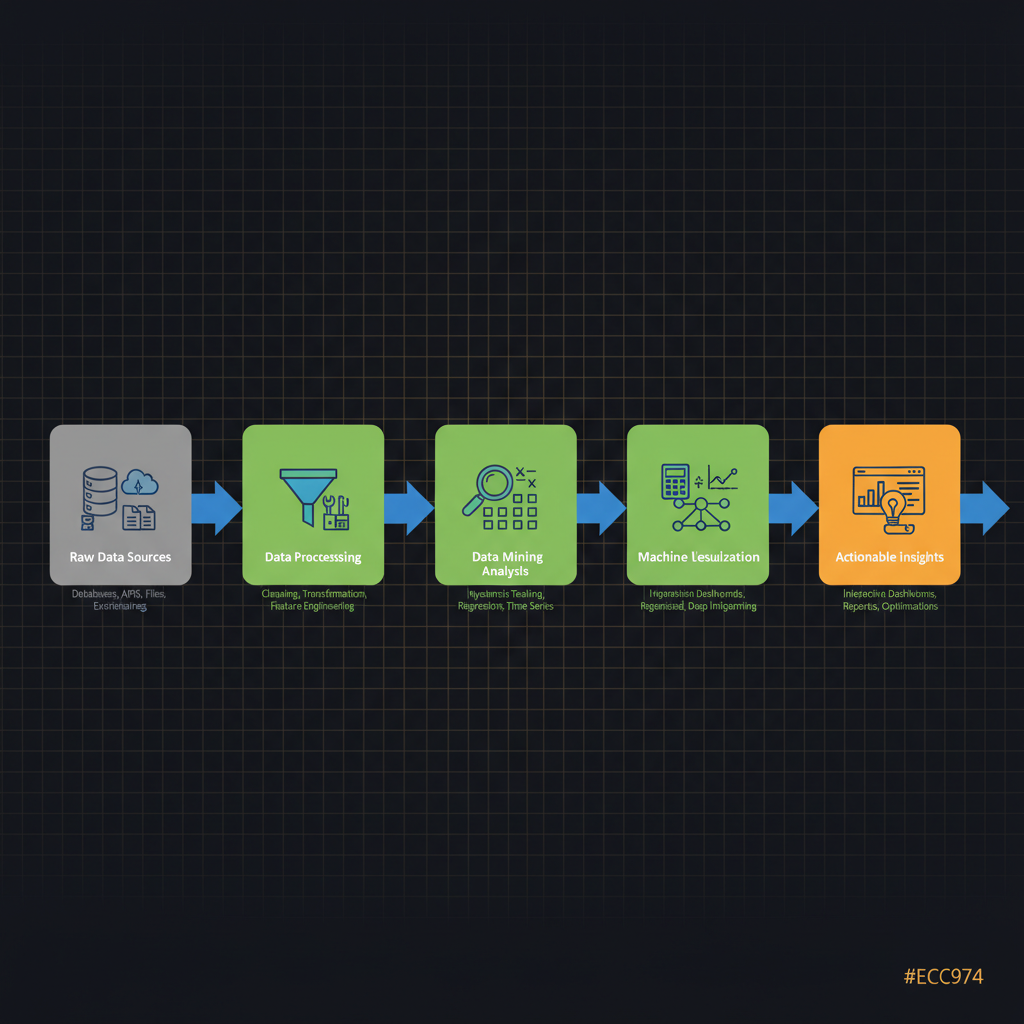
Architecture diagram for Awareness of the process of extracting insights from large datasets using data mining, data visualization, and similar. The data insight extraction pipeline with five sequential stages connected by arrows. Stage 1: Raw Data Sources (database cylinder, cloud storage icon, file stacks) feeds into Stage 2: Data Preprocessing (filter funnel symbol with cleaning tools). Stage 3: Data Mining (magnifying glass over data grid, pattern detection icons) branches into two parallel paths. Stage 4a: Statistical Analysis (calculator, formula symbols) and Stage 4b: Machine Learning Models (neural network node diagram). Both converge into Stage 5: Data Visualization (bar chart, line graph, dashboard display) leading to final output labeled Actionable Insights (lightbulb icon with report document). Use blue for data flow arrows, gray for storage elements, green for processing stages, and orange for final outputs. Include small text labels under each stage describing key techniques like clustering, regression, or interactive dashboards.
You'll be able to
- Apply data mining and visualization techniques to extract actionable insights from large-scale datasets in generative AI workflows, consistent with the exam requirement for awareness of insight extraction processes [^1][^2][^3].
- Evaluate the suitability of different visualization methods (including time-series transformations, semantic graphs, and interactive visual analytics) for revealing patterns, anomalies, and relationships within complex datasets [^5][^6][^7].
- Classify data mining and visualization approaches according to their applicability in production AI contexts, distinguishing between exploratory, diagnostic, and recommendation-generating techniques [^5][^7].
- Create a workflow that integrates data mining, visualization, and insight generation to support decision-making in NVIDIA-aligned generative AI projects, demonstrating competency across the core machine learning, data analysis, and experimentation domains tested on the certification exam [^1][^2][^3].
Key concepts · tap to reveal
1/17·Idea
0%
Idea
01 / 17
The Insight Extraction Challenge
You've just been handed 500 million rows of GPU telemetry from a production inference cluster, and your VP wants to know why token throughput dropped 18% last Tuesday at 2:47 PM. The raw logs sit in object storage, cryptic and unstructured, while your next standup is in four hours. Before you can tune a model, debug a pipeline, or even file a bug report, you need to turn that ocean of numbers into a single, defensible answer.
Your task Write a prompt that asks Claude to recommend the right AI setup for a real task you're facing — then weigh its answer against this lesson, "Awareness of the process of extracting insights from large datasets using data mining, data visualization, and similar."
a strong prompt:role · context · task · format · example
Exercise · scenario
## Scenario **Difficulty Level:** Applied Your team has deployed a fine-tuned generative AI model for building energy optimization, and stakeholders are requesting a dashboard to monitor anomalies and consumption trends across 200 facilities. The raw time-series data is nonlinear and multi-scale, making direct interpretation difficult[^5]. One engineer proposes converting the time-series into 3D graphical representations using continuous wavelet transforms and recurrence plots before feeding them to a vision-based language model for **anomaly detection** and recommendations[^5]. Another suggests building a traditional dashboard with line charts and heat maps, indexed by named entities and relations extracted through natural language processing, to allow stakeholders to explore tag clouds and partial pathways across multiple dimensions[^6]. Both approaches aim to extract actionable insights from the large dataset, aligning with the exam objective on **data mining** and visualization techniques[^1][^2]. What would you do, and why?
Deliverable
You will produce a **Data Insight Extraction Workflow Document** (Markdown format) that demonstrates your awareness of extracting insights from large datasets using **data mining**, visualization, and related techniques aligned with the NVIDIA NCA-GENL exam objectives [^1][^2][^3]. The document must specify a concrete dataset (real or representative), describe at least two data mining or preprocessing steps you would apply, identify one visualization technique suited to the data's structure, and articulate the insight or pattern you aim to extract.
Practice · Scenarios
0 of 8 revealed
Scenario 1 of 8
A telecommunications company's fraud detection team analyzes call detail records from 45 million subscribers, generating 12 terabytes of data monthly. They apply clustering algorithms to identify groups of accounts with similar calling patterns, then flag anomalies such as accounts making hundreds of international calls within minutes or numbers that receive calls but never originate them. The system automatically scores each account's risk level and surfaces the top 0.1% for human investigation. Over six months, this approach identifies 23,000 fraudulent accounts that traditional rule-based systems missed.
Sources
- [1]NVIDIA-Certified Associate: Generative AI LLMs (NCA-GENL) Study Guide·NVIDIA-Certified Associate: Generative AI LLMs (NCA-GENL) Study Guide (2026) · Vendor
- [2]arXiv API·arXiv API (2026) · Research
- [3]arXiv API·arXiv API (2026) · Research
- [4]OpenAlex API·OpenAlex API (2026) · Research
- [5]OpenAlex API·OpenAlex API (2026) · Vendor
Submit your work for review
Paste your capstone artifact below. You'll get back a 4-level rubric grade, per-criterion feedback, and three concrete edits to strengthen it.