
0of18read0 XP

Identify system data, hardware, or software components required to meet user needs.
Classify system data, hardware, and software components according to their role in satisfying specific user requirements in generative AI deployments [^1][^2].
- Time
- 20–25 min
- Type
- exercise
- Bloom
- Apply → Create
- XP
- 100
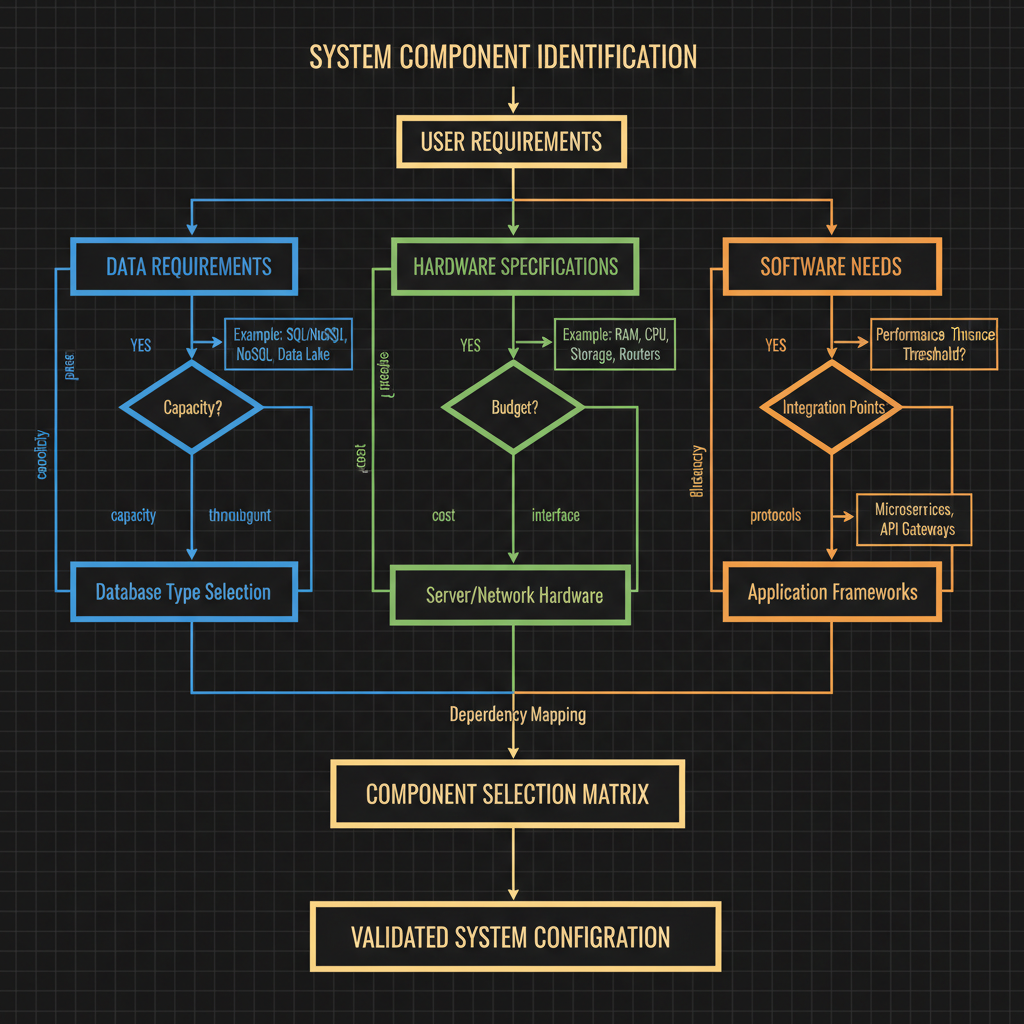
Architecture diagram for Identify system data, hardware, or software components required to meet user needs.. The systematic process of identifying system components to meet user needs. Begin with a "User Requirements" box at top, flowing down through parallel analysis paths for data requirements, hardware specifications, and software needs. Each path contains 2-3 decision diamonds checking constraints like budget, compatibility, and performance thresholds. Paths converge at a "Component Selection Matrix" node, then flow to a final "Validated System Configuration" box. Use blue for data elements, green for hardware, orange for software paths. Include arrows labeled with criteria like "capacity," "scalability," and "integration points." Add small annotation boxes showing example outputs at each stage such as database types, server specs, or application frameworks. Layout should be top-to-bottom with clear hierarchical levels.
You'll be able to
- Classify system data, hardware, and software components according to their role in satisfying specific user requirements in generative AI deployments [^1][^2].
- Evaluate whether a proposed component configuration (GPU specifications, storage architecture, software libraries) adequately addresses documented user needs for a production LLM or multimodal system [^1][^2].
- Apply a systematic identification process to map user-stated functional and non-functional requirements to concrete data sources, compute resources, and software dependencies in an NVIDIA-accelerated AI pipeline [^1][^2].
- Create a justified component specification document that traces each selected hardware element, dataset, and software module back to one or more user needs, demonstrating alignment between requirements and system design [^1][^2].
Key concepts · tap to reveal
1/18·Idea
0%
Idea
01 / 18
The Component Identification Challenge
You've been handed a production ticket: deploy a multimodal RAG pipeline that ingests PDFs, audio transcripts, and video frames, then surfaces answers through a Slack bot by Monday. The infrastructure team asks whether you need A100s or L4s, how much VRAM per node, which vector database, and what storage tier for the embeddings. Marketing wants to know if the system can handle 500 concurrent users. Your manager expects a one-page spec by end-of-day. Every answer hinges on translating vague user requirements into concrete hardware, software, and data decisions[^1].
Your task Write a prompt that asks Claude to recommend the right AI setup for a real task you're facing — then weigh its answer against this lesson, "Identify system data, hardware, or software components required to meet user needs.."
a strong prompt:role · context · task · format · example
Exercise · scenario
## Scenario (Applied) Your team is building a retrieval-augmented generation (RAG) chatbot for a financial services client. The client requires sub-200ms query latency, support for 500 concurrent users, and compliance with data residency rules that mandate all customer records remain on-premises. During the design review, the infrastructure lead proposes a cloud-only deployment using serverless GPU instances, while the compliance officer insists on air-gapped on-premises servers. You must identify which system data, hardware, and software components are actually required to meet these user needs[^1] and justify trade-offs between performance, scale, and regulatory constraints. What would you do, and why?
Deliverable
You will produce a **System Requirements Specification Document** in Markdown format that identifies the data, hardware, and software components necessary to deploy a generative AI solution for a defined user need [^1]. Select a realistic use case (for example, a customer-support chatbot, a document summarization pipeline, or a multimodal content moderation system), then document: (1) the user need and success criteria, (2) required data sources and formats, (3) hardware specifications (GPU type, memory, storage), (4) software dependencies (**frameworks**, libraries, API endpoints), and (5) a…
Practice · Scenarios
0 of 8 revealed
Scenario 1 of 8
A legal research firm wants to build a contract analysis tool that extracts clauses from 2 million historical documents (PDFs, scanned images, Word files) and answers natural language queries from 200 attorneys. The system must handle documents in English, Spanish, and Mandarin, maintain attorney-client privilege with on-premises data storage, and support iterative model improvements as legal precedents evolve. The CTO must decide on the data pipeline and storage architecture.
Sources
- [1]NVIDIA-Certified Associate: Generative AI LLMs (NCA-GENL) Study Guide·NVIDIA-Certified Associate: Generative AI LLMs (NCA-GENL) Study Guide (2026) · Vendor
- [2]NVIDIA-Certified Associate: Generative AI Multimodal (NCA-GENM) Study Guide·NVIDIA-Certified Associate: Generative AI Multimodal (NCA-GENM) Study Guide (2026) · Vendor
- [3]arXiv API·arXiv API (2026) · Research
- [4]OpenAlex API·OpenAlex API (2026) · Research
- [5]W3C Web Content Accessibility Guidelines 2.2·W3C Web Content Accessibility Guidelines 2.2 (2026) · Vendor
- [6]OpenAlex API·OpenAlex API (2026) · Vendor
Submit your work for review
Paste your capstone artifact below. You'll get back a 4-level rubric grade, per-criterion feedback, and three concrete edits to strengthen it.