
0of21read0 XP

Use prompt engineering principles to create prompts to achieve desired results.
Apply prompt engineering principles to craft effective prompts that guide AI models toward desired outcomes in classification, question answering, code generation, and creative writing tasks [^3][^7].
- Time
- 20–25 min
- Type
- exercise
- Bloom
- Apply → Create
- XP
- 100
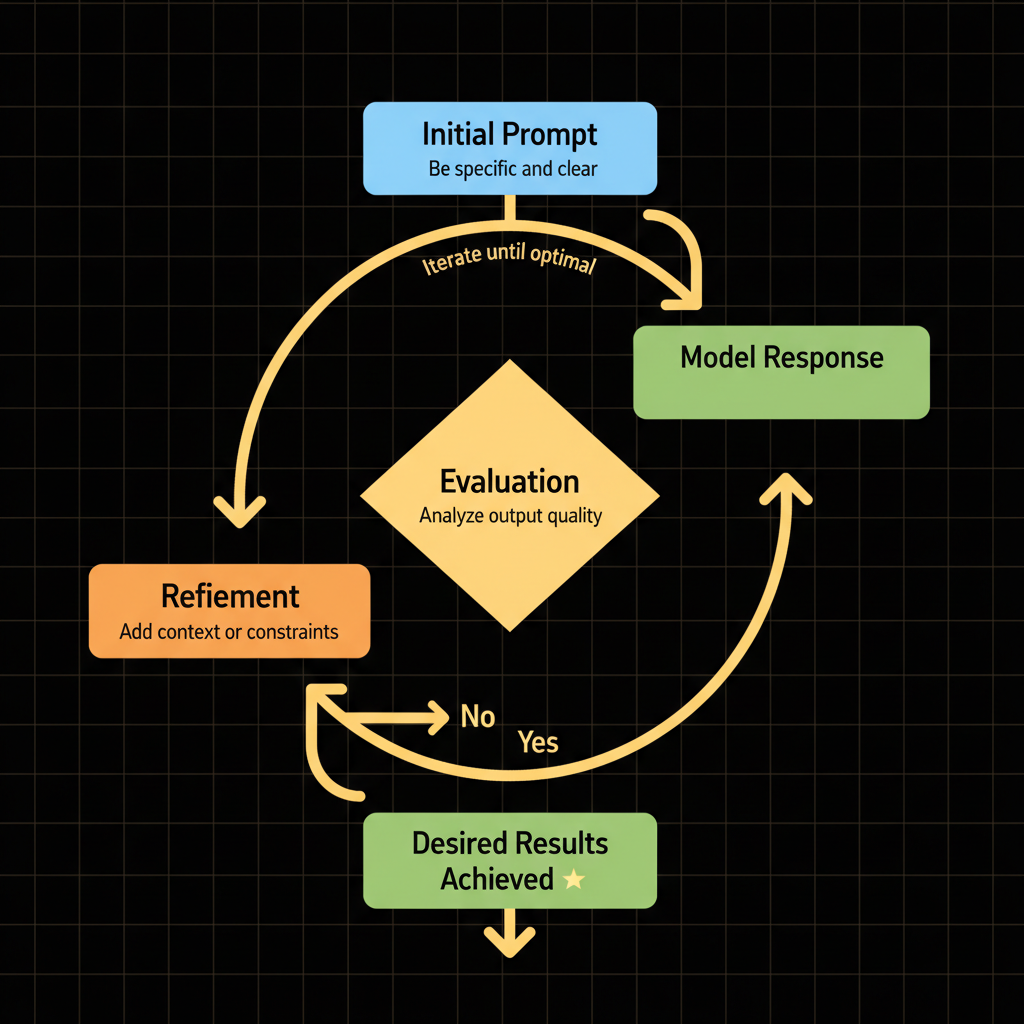
Architecture diagram for Use prompt engineering principles to create prompts to achieve desired results.. The iterative prompt engineering cycle with four main stages arranged in a clockwise loop: Initial Prompt (light blue box), Model Response (green box), Evaluation (yellow diamond decision node), and Refinement (orange box). Connect stages with directional arrows. Show feedback paths from Evaluation back to Refinement when results are unsatisfactory, and a success exit path when desired results are achieved. Include small annotation labels for key principles at each stage: "Be specific and clear" at Initial Prompt, "Analyze output quality" at Evaluation, "Add context or constraints" at Refinement, and "Iterate until optimal" along the feedback loop. Use a clean vertical layout with the decision diamond centered to emphasize the iterative nature of effective prompt engineering.
You'll be able to
- Apply prompt engineering principles to craft effective prompts that guide AI models toward desired outcomes in classification, question answering, code generation, and creative writing tasks [^3][^7].
- Evaluate the quality of prompts by assessing whether they provide clear instructions, appropriate formatting, and sufficient context to elicit relevant, informative, and accurate responses from large language models [^5][^6].
- Create optimized prompts for specific use cases by selecting appropriate words, phrases, sentences, and punctuation that condition the model to generate better responses aligned with task requirements [^3][^7].
- Analyze prompt effectiveness by examining how well-crafted prompts enhance AI model capabilities and mitigate biases to produce fair and equitable outputs [^5][^6].
- Design prompts that account for both the AI model's capabilities and the complexity of the specific task at hand, demonstrating understanding of how prompt quality influences model-generated outputs [^5][^6].
Key concepts · tap to reveal
1/21·Idea
0%
Idea
01 / 21
The Production Prompt Crisis
You're deploying a customer-support chatbot for a Fortune 500 client. The first production run returns technically accurate answers, but users complain the bot sounds "robotic" and "unhelpful." Your manager asks you to fix the output without retraining the model or changing the API endpoint. The difference between a chatbot that delights users and one that drives them to competitors often comes down to a single skill: how you structure the text you send to the language model. Prompt engineering—the practice of strategically designing input to guide AI models toward desired outcomes—directly determines whether your generative AI application meets production quality or falls short.
Your task Write a prompt that asks Claude to recommend the right AI setup for a real task you're facing — then weigh its answer against this lesson, "Use prompt engineering principles to create prompts to achieve desired results.."
a strong prompt:role · context · task · format · example
Exercise · scenario
## Scenario **Difficulty Level:** Applied You are deploying a customer-support chatbot powered by an LLM on Amazon Bedrock. Initial tests show the model frequently generates verbose, off-topic responses when users ask about return policies. Your manager asks you to improve output quality without retraining the model. You have access to the prompt template, which currently reads: "Answer the user's question." You know that strategically designing and structuring prompts can guide AI models toward desired outcomes and ensure relevant, accurate responses[^5]. You also recognize that the quality of prompts directly impacts the quality of the model's responses[^7]. What would you do, and why?
Deliverable
You will produce a **Prompt Engineering Portfolio** as a markdown document that demonstrates your ability to apply **prompt engineering** principles to achieve desired results aligned with the NVIDIA NCA-GENL exam objective [^1]. The portfolio must contain three distinct prompt artifacts: (1) a baseline prompt for a specified generative AI task (such as **code generation**, **classification**, or creative writing [^7]), (2) an engineered version of that prompt incorporating at least three optimization techniques (such as strategic word choice, structural formatting, or clear instruction…
Practice · Scenarios
0 of 8 revealed
Scenario 1 of 8
A customer service manager at an e-commerce startup is deploying a chatbot to handle return requests. Early testing shows the bot sometimes approves returns outside the 30-day policy window and uses inconsistent tone (sometimes formal, sometimes casual). The company has a detailed return policy document and brand voice guidelines emphasizing friendly professionalism. The manager needs to ensure policy compliance while maintaining brand voice.
Sources
- [1]AWS Bedrock Developer / User Guide·AWS Bedrock Developer / User Guide (2026) · Vendor
- [2]OpenAlex API·OpenAlex API (2026) · Research
- [3]NVIDIA-Certified Associate: Generative AI LLMs (NCA-GENL) Study Guide·NVIDIA-Certified Associate: Generative AI LLMs (NCA-GENL) Study Guide (2026) · Vendor
- [4]NVIDIA-Certified Associate: Generative AI Multimodal (NCA-GENM) Study Guide·NVIDIA-Certified Associate: Generative AI Multimodal (NCA-GENM) Study Guide (2026) · Vendor
Submit your work for review
Paste your capstone artifact below. You'll get back a 4-level rubric grade, per-criterion feedback, and three concrete edits to strengthen it.