
0of22read0 XP

Describe the ethical principles of trustworthy AI.
Classify AI systems according to the ethical principles of trustworthy AI (beneficence, non-maleficence, explicability, autonomy, and justice) as defined in international frameworks[^3][^4][^7].
- Time
- 20–25 min
- Type
- exercise
- Bloom
- Understand → Evaluate
- XP
- 100
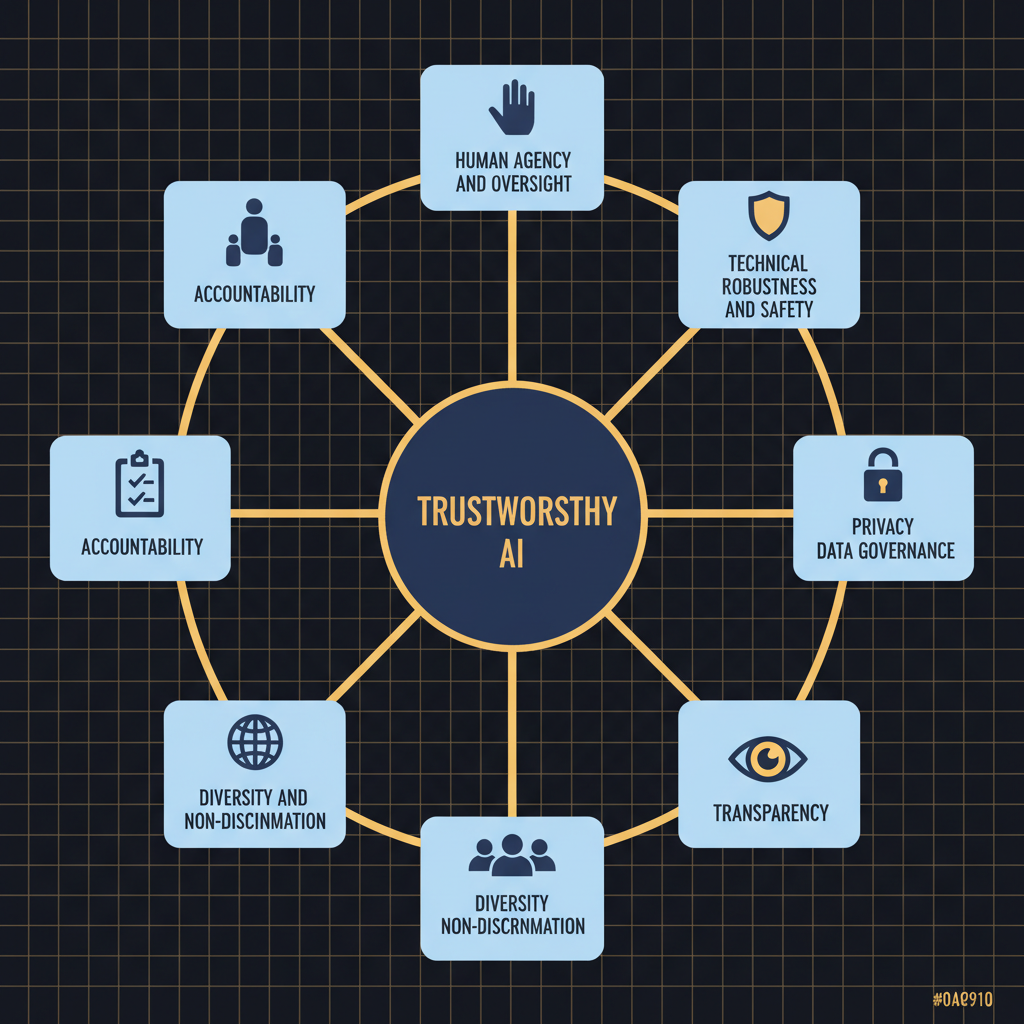
Architecture diagram for Describe the ethical principles of trustworthy AI.. Create a circular hub-and-spoke diagram showing the seven ethical principles of trustworthy AI radiating from a central "Trustworthy AI" node. Each spoke connects to a principle box labeled: Human Agency and Oversight, Technical Robustness and Safety, Privacy and Data Governance, Transparency, Diversity and Non-discrimination, Societal and Environmental Wellbeing, and Accountability. Use a clean white background with the central hub in deep blue, principle boxes in lighter blue with dark text, and connecting lines in gray. Position principles equidistantly around the hub to emphasize equal importance. Include small icons within each principle box: a hand for human agency, a shield for robustness, a lock for privacy, an eye for transparency, diverse figures for diversity, a globe for societal wellbeing, and a checklist for accountability.
You'll be able to
- Classify AI systems according to the ethical principles of trustworthy AI (beneficence, non-maleficence, explicability, autonomy, and justice) as defined in international frameworks[^3][^4][^7].
- Evaluate a generative AI application against the core ethical principles of trustworthy AI, identifying potential violations and proposing design interventions to align with human rights and democratic values[^4][^5].
- Apply the ethical principles of trustworthy AI to requirements elicitation for an NVIDIA-aligned AI project, specifying measurable ethicality requirements that address algorithmic transparency, fairness, and user autonomy[^3][^6].
- Explain how the OECD AI Principles and related frameworks guide AI actors in developing trustworthy systems, and how these principles inform regulatory approaches across jurisdictions[^4].
Key concepts · tap to reveal
1/22·Idea
0%
Idea
01 / 22
When Technical Success Masks Ethical Failure
You're deploying a student-performance prediction system that flags at-risk learners for early intervention. During pilot testing, teachers notice the AI consistently underestimates students from lower-income neighborhoods, steering resources away from those who need them most. The system works technically—accuracy metrics look solid—but the real-world outcome violates fairness in ways your team never anticipated. Before expanding to twenty more schools, you need to understand which ethical principles should have guided design from day one, and how to apply them when technical success and human impact diverge.
Your task Write a prompt that asks Claude to recommend the right AI setup for a real task you're facing — then weigh its answer against this lesson, "Describe the ethical principles of trustworthy AI.."
a strong prompt:role · context · task · format · example
Exercise · scenario
## Scenario (Applied) Your team is deploying a generative AI system to predict student performance and flag learners at risk of course failure. The model achieves 87% accuracy in internal tests. During a design review, a colleague proposes launching with predictions only, arguing that showing confidence scores or feature explanations will confuse instructors and slow adoption. Another engineer warns that the training data may reflect historical biases related to socioeconomic background, and that deploying without transparency mechanisms could lead to unfair interventions or privacy concerns [^5]. The **OECD AI Principles** emphasize that **trustworthy AI** must respect **human rights** and democratic values [^4], and research on similar educational AI systems highlights risks including unacceptable discrimination and breaches of privacy when vulnerable individuals' data is analyzed [^5]. You must decide whether to ship the prediction-only version now or delay the release to add explainability and bias-monitoring features. **What would you do, and why?**
Deliverable
At the conclusion of this lesson, you will produce a **Trustworthy AI Principles Assessment Matrix** as a markdown document. This artifact consists of a table that maps each ethical principle of **trustworthy AI** (as defined by the **OECD AI Principles** and referenced in the NCA-GENL exam objectives) to a concrete technical control or design guideline applicable to generative AI systems [^1][^4].
Practice · Scenarios
0 of 8 revealed
Scenario 1 of 8
An educational technology company develops a generative AI tutor that creates personalized learning content for K-12 students. The system collects detailed interaction data: time spent on each problem, keystroke patterns, facial expressions via webcam (to detect confusion), and voice recordings of students reading aloud. This data trains the model to adapt content difficulty in real-time. Parents receive weekly reports showing their child's engagement metrics. The company's privacy policy, written in legal language spanning 47 pages, states that anonymized data may be shared with 'trusted partners for research purposes.' A teacher discovers that student interaction patterns are being sold to a marketing firm that targets educational product ads to families based on inferred learning disabilities.
Quiz · adaptive · 3 items
Mastery check
Match each term to its definition. Pass at 80% to earn the lesson's XP and unlock the next.
Sources
- [1]OpenAlex API·OpenAlex API (2026) · Research
- [2]OpenAlex API·OpenAlex API (2026) · Research
- [3]OECD AI Principles (2019, updated 2024)·OECD AI Principles (2019, updated 2024) (2026) · Vendor
- [4]OpenAlex API·OpenAlex API (2026) · Research
- [5]OpenAlex API·OpenAlex API (2026) · Research
- [6]NVIDIA-Certified Associate: Generative AI LLMs (NCA-GENL) Study Guide·NVIDIA-Certified Associate: Generative AI LLMs (NCA-GENL) Study Guide (2026) · Vendor
- [7]NVIDIA-Certified Associate: Generative AI Multimodal (NCA-GENM) Study Guide·NVIDIA-Certified Associate: Generative AI Multimodal (NCA-GENM) Study Guide (2026) · Vendor
- [8]OpenAlex API·OpenAlex API (2026) · Vendor
Submit your work for review
Paste your capstone artifact below. You'll get back a 4-level rubric grade, per-criterion feedback, and three concrete edits to strengthen it.