
0of20read0 XP

Describe the balance between data privacy and the importance of data consent.
Evaluate whether existing data collection consent is sufficient for generative AI model training, distinguishing between general data use permissions and ML-specific consent requirements [^5][^6].
- Time
- 20–25 min
- Type
- exercise
- Bloom
- Understand → Create
- XP
- 100
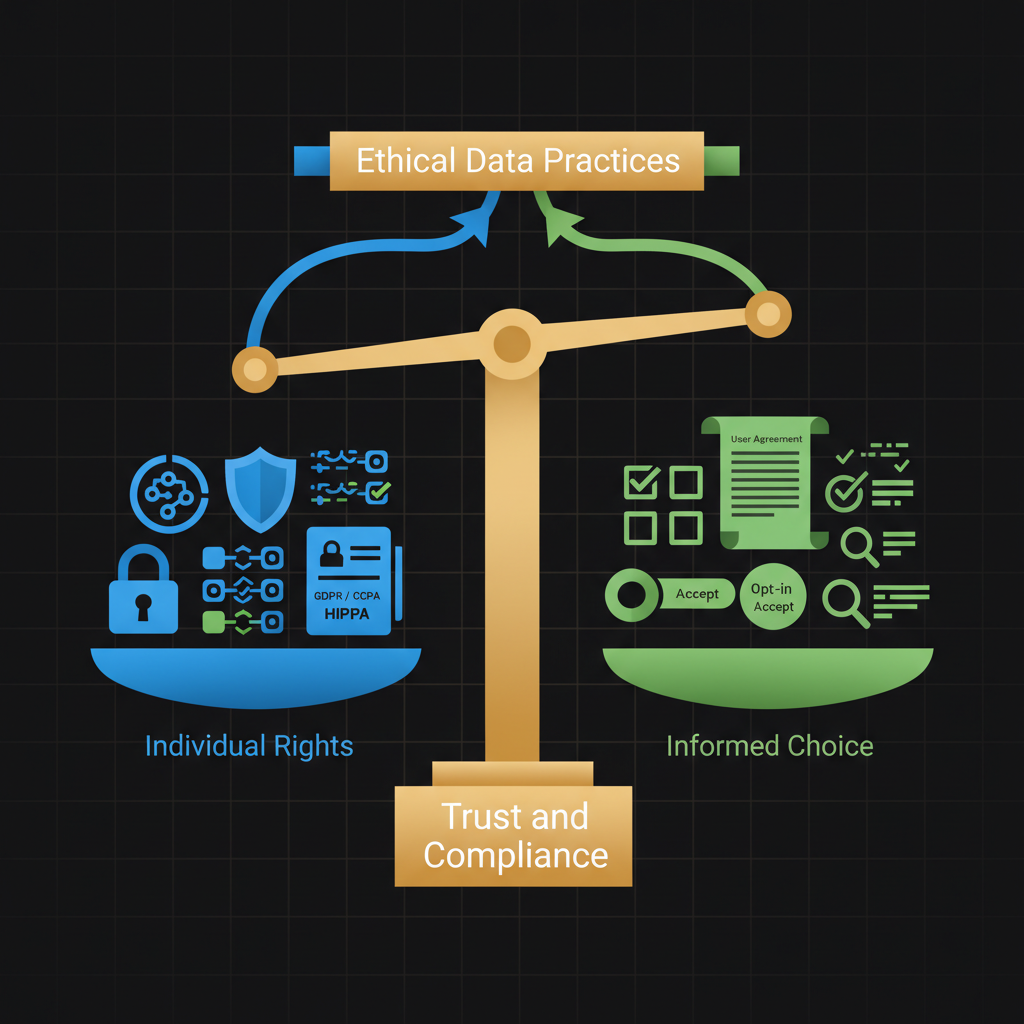
Architecture diagram for Describe the balance between data privacy and the importance of data consent.. Create a balance-scale diagram showing data privacy on the left pan and data consent on the right pan, with a central fulcrum labeled "Trust and Compliance." The left side should display icons representing privacy elements: locked padlock, shield, encrypted data symbols, and GDPR/regulatory text. The right side should show consent elements: checkboxes, user agreement document, opt-in buttons, and transparent disclosure icons. Use blue tones for privacy elements and green tones for consent elements. Add arrows connecting both sides to a top banner labeled "Ethical Data Practices" to illustrate their interdependence. Include small text labels indicating "Individual Rights" under privacy and "Informed Choice" under consent. The scales should appear level to emphasize equilibrium between protecting personal information and obtaining proper user authorization for data processing activities.
You'll be able to
- Evaluate whether existing data collection consent is sufficient for generative AI model training, distinguishing between general data use permissions and ML-specific consent requirements [^5][^6].
- Apply privacy-preserving techniques to balance data utility with consent obligations when designing AI systems that handle personal information [^3][^5].
- Classify common anti-patterns in data consent management for AI applications, including assumptions about purpose limitation and failures to document consent mechanisms [^5].
- Create a compliance verification process that addresses data subject rights, including mechanisms to handle withdrawn consent and requests for data removal from training sets [^5][^7].
- Explain the relationship between privacy regulations, explicit user consent requirements, and trustworthy AI implementation in production generative AI systems [^4][^6][^7].
Key concepts · tap to reveal
1/20·Idea
0%
Idea
01 / 20
The Privacy-Consent Dilemma in AI Deployment
You're deploying a customer-support chatbot trained on millions of historical service tickets when legal flags a question: did the customers who wrote those tickets consent to their data being used to train an AI model? The original terms of service covered "service improvement," but machine learning wasn't explicitly mentioned. Now you face a choice between scrapping months of work or risking regulatory penalties under privacy laws that demand specific consent for automated decision-making. This tension between leveraging data to build better AI systems and respecting individual privacy rights sits at the heart of every generative AI deployment.
Your task Write a prompt that asks Claude to recommend the right AI setup for a real task you're facing — then weigh its answer against this lesson, "Describe the balance between data privacy and the importance of data consent.."
a strong prompt:role · context · task · format · example
Exercise · scenario
## Scenario (Applied) Your team is building a customer-support chatbot that will be fine-tuned on historical support tickets collected over the past three years. The original privacy notice informed customers that their data would be used "to deliver and improve our services," but it did not explicitly mention machine learning **model training**[^5]. Legal has flagged that some jurisdictions require specific consent for ML usage beyond general service improvement[^6], and two customers have already submitted requests to withdraw consent and have their data removed from any training datasets[^5]. Meanwhile, your project timeline assumes the full historical dataset will be available for training next week. What would you do, and why?
Deliverable
You will produce a **Data Privacy and Consent Decision Matrix** as a markdown document that maps three realistic generative AI use cases (e.g., customer support chatbot training, employee productivity assistant, public-facing content generator) to consent requirements, privacy controls, and data-handling guardrails.
Practice · Scenarios
0 of 8 revealed
Scenario 1 of 8
A multinational retail corporation operates loyalty programs across 15 countries, collecting purchase history, location data, and demographic information. The marketing team wants to create unified customer profiles for personalized recommendations across all touchpoints. Legal counsel identifies that consent requirements vary significantly by jurisdiction—GDPR requires explicit opt-in in Europe, while some Asian markets allow opt-out models. The data governance board must establish a consent framework that enables global personalization while respecting regional privacy expectations. Engineering estimates that maintaining separate consent systems would increase infrastructure costs by 40%.
Sources
- [1]AWS Well-Architected Framework: Machine Learning Lens·AWS Well-Architected Framework: Machine Learning Lens (2026) · Vendor
- [2]Google Cloud Generative AI Leader Exam Guide·Google Cloud Generative AI Leader Exam Guide (2026) · Vendor
- [3]W3C Web Content Accessibility Guidelines 2.2·W3C Web Content Accessibility Guidelines 2.2 (2026) · Vendor
- [4]OpenAlex API·OpenAlex API (2026) · Vendor
- [5]NVIDIA-Certified Associate: Generative AI LLMs (NCA-GENL) Study Guide·NVIDIA-Certified Associate: Generative AI LLMs (NCA-GENL) Study Guide (2026) · Vendor
- [6]NVIDIA-Certified Associate: Generative AI Multimodal (NCA-GENM) Study Guide·NVIDIA-Certified Associate: Generative AI Multimodal (NCA-GENM) Study Guide (2026) · Vendor
Submit your work for review
Paste your capstone artifact below. You'll get back a 4-level rubric grade, per-criterion feedback, and three concrete edits to strengthen it.