
0of20read0 XP

Assist in deployment and evaluation of model scalability, performance, and reliability under the supervision of senior team members.
Apply deployment procedures for generative AI models in supervised production environments, demonstrating adherence to task 1.1 of the NCA-GENL exam objectives[^1].
- Time
- 20–25 min
- Type
- exercise
- Bloom
- Apply → Evaluate
- XP
- 100
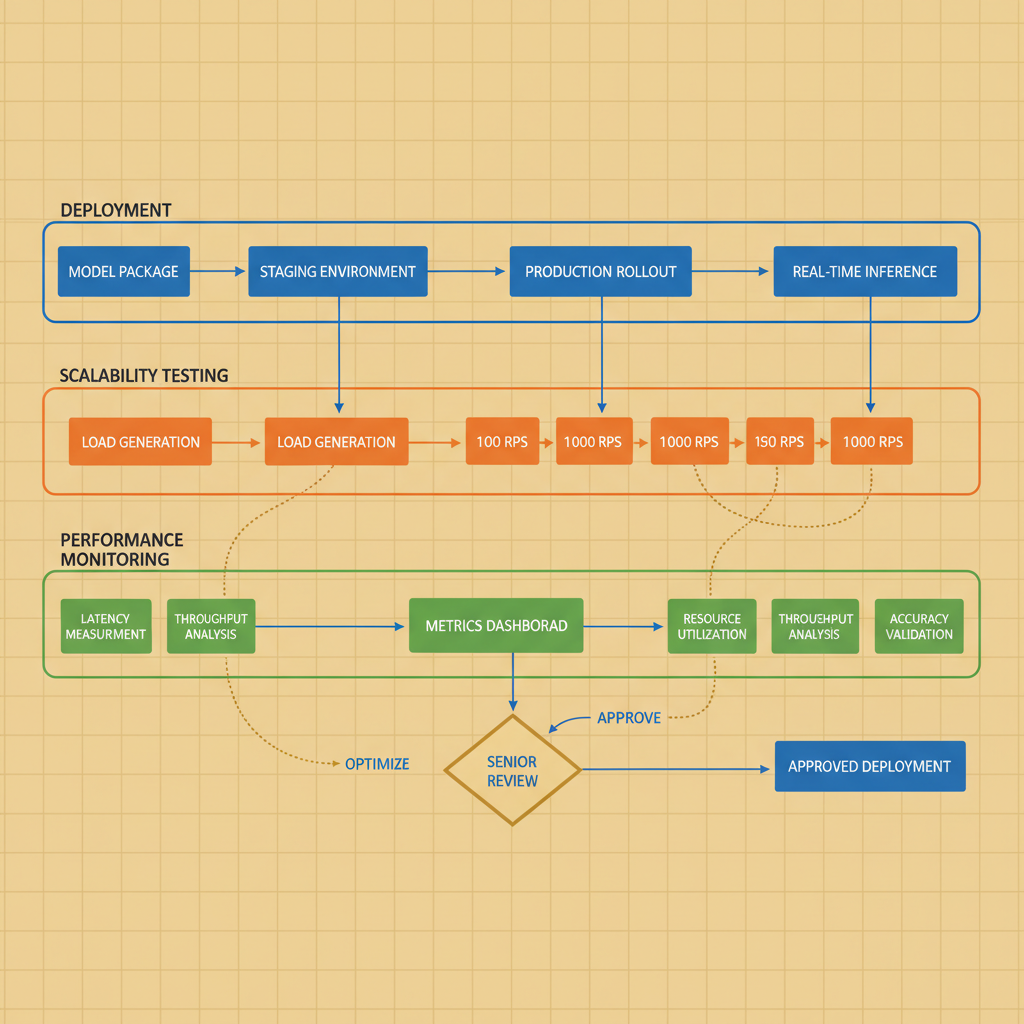
Architecture diagram for Assist in deployment and evaluation of model scalability, performance, and reliability under the supervision of senior team members.. The model deployment and evaluation pipeline with three parallel swim lanes labeled "Deployment," "Scalability Testing," and "Performance Monitoring." The flow begins with "Model Package" at the left, moves through deployment stages (staging environment, production rollout), then branches into concurrent evaluation paths. The scalability lane shows load testing with increasing request volumes (100, 1000, 10000 RPS) feeding into resource utilization metrics. The performance lane displays latency measurement, throughput analysis, and accuracy validation boxes. Both lanes converge at a "Metrics Dashboard" node, which connects to a "Senior Review" decision diamond that either loops back for optimization or proceeds to "Approved Deployment." Use blue for deployment actions, orange for testing activities, and green for monitoring components. Include dotted lines showing feedback loops between evaluation results and deployment adjustments.
You'll be able to
- Apply deployment procedures for generative AI models in supervised production environments, demonstrating adherence to task 1.1 of the NCA-GENL exam objectives[^1].
- Evaluate model scalability characteristics by measuring performance metrics under varying load conditions, following the deployment and evaluation framework specified in task 1.1[^1].
- Classify reliability indicators and performance bottlenecks in deployed models, supporting senior team members in assessment activities as outlined in the exam task body[^1].
- Execute systematic evaluation protocols for model performance and reliability, applying the assist-level responsibilities defined in both Domain 1 and Domain 4 of the certification requirements[^1][^2].
- Document scalability, performance, and reliability findings in formats suitable for senior team review, enabling effective collaboration within the supervised deployment context described in task 1.1[^1].
Key concepts · tap to reveal
1/20·Idea
0%
Idea
01 / 20
When Models Meet Reality
You're three days into your new role as a junior ML engineer when your team lead asks you to help push a fine-tuned language model into production. The model passes validation on the test set, but once deployed to serve real user traffic, response times spike to 12 seconds and memory usage climbs until the container restarts. Your senior engineer needs you to gather performance metrics, identify the bottleneck, and propose whether the issue stems from batch size, quantization settings, or infrastructure limits. Models that perform well in notebooks often reveal scalability and reliability problems only when they meet production load.
Your task Write a prompt that asks Claude to recommend the right AI setup for a real task you're facing — then weigh its answer against this lesson, "Assist in deployment and evaluation of model scalability, performance, and reliability under the supervision of senior team members.."
a strong prompt:role · context · task · format · example
Exercise · scenario
## Scenario **Difficulty Level: Applied** You are a junior ML engineer supporting a team deploying a fine-tuned generative AI model for customer support ticket summarization. During initial load testing, you notice that response **latency** spikes to 8 seconds when concurrent requests exceed 50 users, well above the target of under 2 seconds. Your senior engineer is in back-to-back meetings for the next three hours. The **deployment** is scheduled to go live in two days, and the infrastructure team is asking whether to proceed with the current configuration or delay the release. **What would you do, and why?** *Consider your responsibilities under task 1.1 of the NCA-GENL exam objectives,[^1] the scope of assistance expected when working under supervision,[^2] and the trade-offs between gathering complete performance data and escalating time-sensitive **deployment** decisions.*
Deliverable
You will produce a **Deployment Evaluation Checklist** as a Markdown document that captures the key **scalability**, performance, and reliability criteria you would use when assisting senior team members in a production model **deployment** [^1][^2]. The checklist must include at least three sections: one for **scalability** indicators (such as **throughput** under load or resource utilization), one for **performance metrics** (such as **latency**, accuracy, or inference time), and one for reliability checks (such as error rates, fallback behavior, or monitoring thresholds).
Practice · Scenarios
0 of 8 revealed
Scenario 1 of 8
You are supporting a senior data scientist at an e-commerce company deploying a product recommendation LLM. The model generates personalized shopping suggestions based on user browsing history. In your testing environment with synthetic data, the model consistently returns recommendations in 450ms. However, when deployed to production with real user traffic, you observe that response times average 4.2 seconds during business hours. The traffic volume in production is similar to your test load (approximately 200 requests per minute), but production data includes richer user histories with 10x more browsing events per user. Your supervisor asks you to identify the primary deployment concern.
Sources
- [1]NVIDIA-Certified Associate: Generative AI LLMs (NCA-GENL) Study Guide·NVIDIA-Certified Associate: Generative AI LLMs (NCA-GENL) Study Guide (2026) · Vendor
- [2]NVIDIA-Certified Associate: Generative AI Multimodal (NCA-GENM) Study Guide·NVIDIA-Certified Associate: Generative AI Multimodal (NCA-GENM) Study Guide (2026) · Vendor
- [3]OpenAlex API·OpenAlex API (2026) · Vendor
Submit your work for review
Paste your capstone artifact below. You'll get back a 4-level rubric grade, per-criterion feedback, and three concrete edits to strengthen it.