
0of20read0 XP

Write software components or scripts under the supervision of a senior team member.
Implement transformer-based models for text classification, named entity recognition, and question-answering tasks using modern deep learning frameworks under senior guidance[^1].
- Time
- 20–25 min
- Type
- exercise
- Bloom
- Apply → Create
- XP
- 100
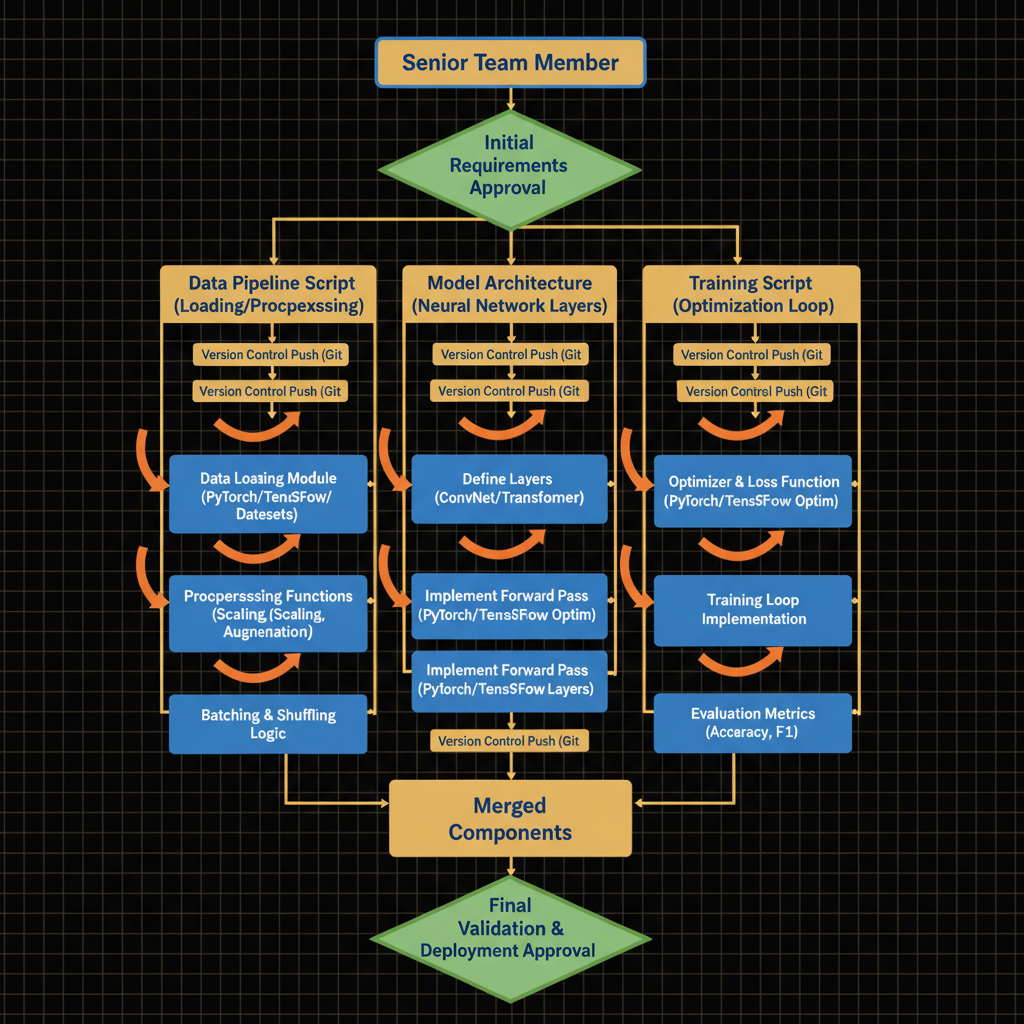
Architecture diagram for Write software components or scripts under the supervision of a senior team member.. The supervised software development workflow for writing deep learning components. At the top, show "Senior Team Member" providing initial requirements and code review checkpoints. Below that, branch into three parallel swim lanes: "Data Pipeline Script" (loading/preprocessing), "Model Architecture Component" (neural network layers), and "Training Script" (optimization loop). Each lane contains 2-3 sequential boxes representing coding steps with feedback arrows looping back to the senior reviewer. Use blue for developer actions, green for approval gates, and orange for iteration cycles. Include labels for common deep learning frameworks (PyTorch/TensorFlow) and version control integration points. Bottom shows merged components feeding into a final validation step.
You'll be able to
- Implement transformer-based models for text classification, named entity recognition, and question-answering tasks using modern deep learning frameworks under senior guidance[^1].
- Apply transfer learning techniques between pretrained models to achieve efficient results with less data and computation in supervised development workflows[^1][^5].
- Develop inference-ready software components that deploy refined models for live applications, following best practices for model serving and API integration[^1].
- Evaluate the performance of custom scripts against project requirements by testing model outputs on representative datasets and comparing results with baseline metrics[^1][^7].
- Create application code that harnesses large language models for generative tasks, document analysis, and chatbot applications while adhering to team coding standards and version control practices[^1].
Key concepts · tap to reveal
1/20·Idea
0%
Idea
01 / 20
The Real-World Stakes of Supervised Development
You're three weeks into your first AI engineering role when your team lead assigns you a critical task: write a Python script that fine-tunes a transformer model for named entity recognition, then deploy it to a Triton Inference Server for production use. She schedules daily check-ins, shares a starter notebook, and asks you to document every design choice. Your script will process customer support tickets in a live application—a poorly written component could bottleneck inference, hallucinate entity labels, or fail silently under load. This is where theoretical knowledge meets production reality.
Your task Write a prompt that asks Claude to recommend the right AI setup for a real task you're facing — then weigh its answer against this lesson, "Write software components or scripts under the supervision of a senior team member.."
a strong prompt:role · context · task · format · example
Exercise · scenario
## Scenario **Difficulty Level:** Applied You are a junior AI engineer at a company building a conversational AI application using NVIDIA Riva. Your senior team member has asked you to write a Python script that customizes and deploys an automatic speech recognition (ASR) model on Riva[^2]. You have completed a draft implementation using **PyTorch** and NVIDIA's recommended frameworks[^1][^5], but before submitting your code for review, you notice that your script lacks inline comments explaining the model architecture choices and does not include error handling for GPU memory allocation failures. Your senior colleague is scheduled to review your work in two hours, and you estimate it will take 90 minutes to add comprehensive documentation and robust error handling, or 15 minutes to add minimal comments only. **What would you do, and why?**
Deliverable
You will produce a **supervised code review submission package** that demonstrates your ability to write software components under senior guidance. Create a markdown document titled `code-review-submission.md` that contains: (1) a Python script or module implementing one LLM or multimodal AI capability aligned with the NVIDIA course objectives—such as a transformer-based text classifier, a prompt-engineering wrapper for document analysis, or a CLIP-based image-from-text generator[^1][^2][^6]; (2) inline comments identifying three design decisions where you applied a best practice from the…
Practice · Scenarios
0 of 8 revealed
Scenario 1 of 8
A junior ML engineer at an e-commerce company is building a text classification component for product reviews using Keras. The senior engineer provides a baseline model architecture and asks the junior to implement data augmentation functions that generate synthetic training examples. The junior engineer finds a complex augmentation library online that could improve results but requires learning a new API and refactoring the existing pipeline. The project deadline is in two weeks. How should the junior engineer proceed?
Sources
- [1]NVIDIA-Certified Associate: Generative AI LLMs (NCA-GENL) Study Guide·NVIDIA-Certified Associate: Generative AI LLMs (NCA-GENL) Study Guide (2026) · Vendor
- [2]NVIDIA-Certified Associate: Generative AI Multimodal (NCA-GENM) Study Guide·NVIDIA-Certified Associate: Generative AI Multimodal (NCA-GENM) Study Guide (2026) · Vendor
Submit your work for review
Paste your capstone artifact below. You'll get back a 4-level rubric grade, per-criterion feedback, and three concrete edits to strengthen it.