
0of23read0 XP

Read research papers (articles, conference papers, etc.) to identify emerging LLM trends and technologies.
Classify research papers by their contribution type (empirical study, systematic review, technical innovation, or bibliometric analysis) and determine which papers best reveal emerging LLM trends versus established knowledge [^1][^4][^5].
- Time
- 20–25 min
- Type
- exercise
- Bloom
- Apply → Create
- XP
- 100
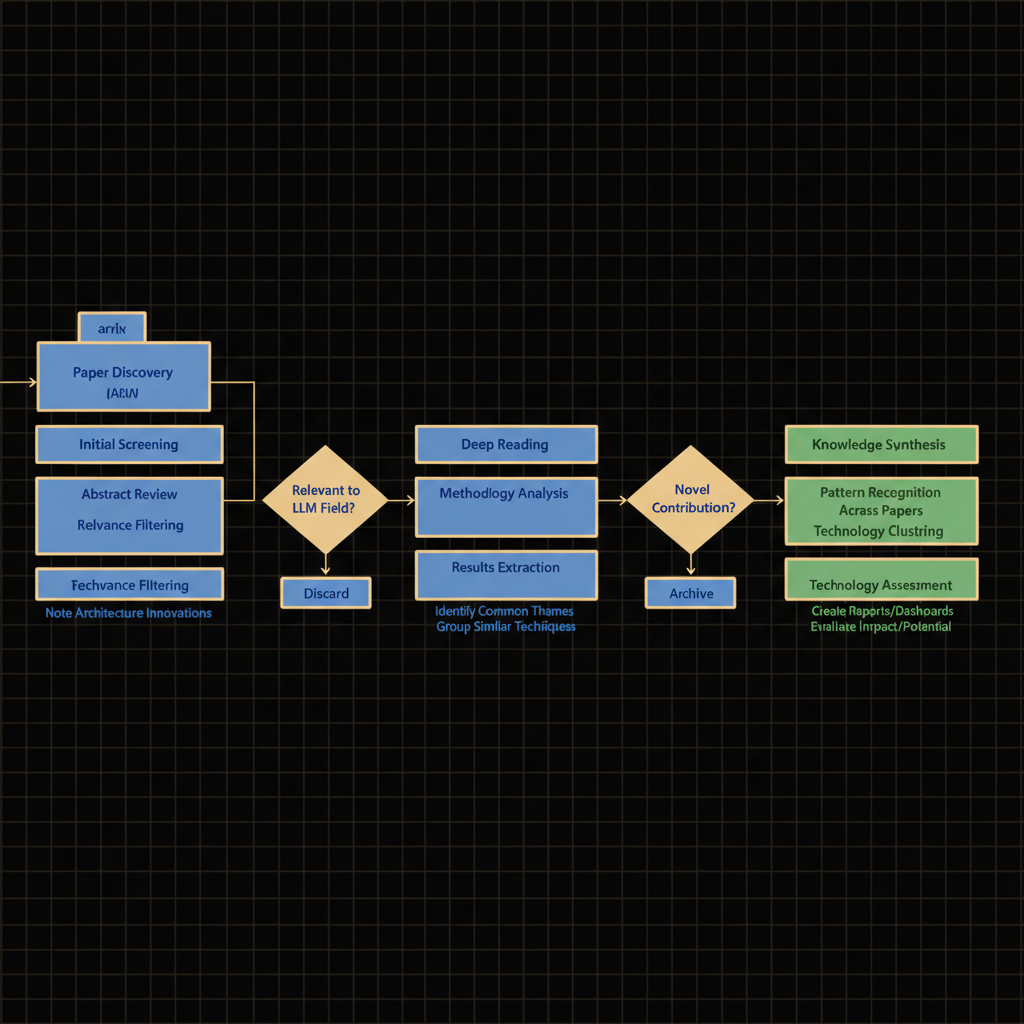
Architecture diagram for Read research papers (articles, conference papers, etc.) to identify emerging LLM trends and technologies.. The systematic process of reading and analyzing LLM research papers to identify emerging trends. The diagram should flow left to right with five main stages: Paper Discovery (showing sources like arXiv, ACL, NeurIPS), Initial Screening (abstract review, relevance filtering), Deep Reading (methodology analysis, results extraction), Trend Identification (pattern recognition across papers, technology clustering), and Knowledge Synthesis (trend documentation, technology assessment). Use rectangular boxes for process steps, diamond shapes for decision points like "Relevant to LLM field?" and "Novel contribution?", and arrows showing the workflow. Include annotations for key activities at each stage such as "note architecture innovations" and "compare benchmarks". Use blue tones for reading activities and green for analysis outputs.
You'll be able to
- Classify research papers by their contribution type (empirical study, systematic review, technical innovation, or bibliometric analysis) and determine which papers best reveal emerging LLM trends versus established knowledge [^1][^4][^5].
- Evaluate the methodological rigor and citation impact of LLM-related research to prioritize high-signal sources when tracking technology shifts, applying criteria such as sample size, replication design, and inter-rater reliability metrics [^3][^4].
- Apply systematic literature review techniques to extract trend patterns from multiple papers, including keyword clustering, temporal publication analysis, and identification of research hot spots in generative AI domains [^2][^5][^6].
- Synthesize findings from conference papers and journal articles into actionable intelligence for NVIDIA-aligned production contexts, distinguishing between theoretical advances and deployment-ready techniques [^1][^8].
- Create a personal research monitoring workflow that integrates multiple publication sources and filters for LLM developments relevant to your certification domain, using reproducible search and analysis methods [^4][^5][^6].
Key concepts · tap to reveal
1/23·Idea
0%
Idea
01 / 23
Why reading research papers matters for LLM practitioners
You're evaluating three new open-source LLM architectures for a production chatbot. Your manager asks which handles multi-turn context best and whether any use a novel attention mechanism that might reduce inference cost. Vendor blogs are marketing fluff. The only way to get ground truth is to pull the original conference papers, compare reported benchmarks, and understand what each architecture actually changed under the hood[^8]. Missing a key trade-off could mean deploying a model that doubles your token budget or fails on the exact conversational patterns your users need[^4].
Your task Write a prompt that asks Claude to recommend the right AI setup for a real task you're facing — then weigh its answer against this lesson, "Read research papers (articles, conference papers, etc.) to identify emerging LLM trends and technologies.."
a strong prompt:role · context · task · format · example
Exercise · scenario
## Scenario (Applied) You are a machine-learning engineer at a healthcare AI startup preparing to pitch a new conversational agent for patient triage. Your VP of Engineering asks you to scan recent research literature to determine whether LLMs can reliably handle multi-turn clinical dialogues and what emerging architectures might reduce hallucination risk in medical contexts. You have access to **arXiv**, PubMed, ACM Digital Library, and your company's Scopus subscription. The pitch meeting is in three days, and the VP expects you to present two or three concrete findings—each backed by a peer-reviewed source—that either support or challenge the feasibility of your product roadmap.
Deliverable
You will produce a **Research Trend Briefing Document** in Markdown format that synthesizes findings from three recent LLM or generative-AI research papers you select and read [^1]. The document must include: (1) a one-paragraph executive summary of each paper (author, venue, core contribution), (2) a comparative analysis section identifying at least two cross-cutting trends or technical directions the papers share (for example, efficiency improvements, multimodal fusion, or safety alignment), and (3) a "Implications for Practice" subsection that maps one trend to a concrete NVIDIA-aligned…
Practice · Scenarios
0 of 8 revealed
Scenario 1 of 8
An automotive AI lead reviews an arXiv paper titled 'Sparse Mixture-of-Experts for Real-Time Sensor Fusion' claiming 3x inference speedup on edge devices while maintaining 98% of dense model accuracy. The paper tests on KITTI and nuScenes datasets using a custom 12B parameter MoE architecture. The authors are from a top-tier university lab with strong publication history. However, the paper was submitted two days ago, cites no prior MoE work after 2021, and reports results only on NVIDIA A100 GPUs rather than actual automotive-grade hardware. The lead's team is selecting architectures for a 2025 production vehicle.
Sources
- [1]OpenAlex API·OpenAlex API (2026) · Research
- [2]OpenAlex API·OpenAlex API (2026) · Vendor
- [3]NVIDIA-Certified Associate: Generative AI LLMs (NCA-GENL) Study Guide·NVIDIA-Certified Associate: Generative AI LLMs (NCA-GENL) Study Guide (2026) · Vendor
- [4]OpenAlex API·OpenAlex API (2026) · Research
- [5]OpenAlex API·OpenAlex API (2026) · Vendor
- [6]OpenAlex API·OpenAlex API (2026) · Research
- [7]OpenAlex API·OpenAlex API (2026) · Research
Submit your work for review
Paste your capstone artifact below. You'll get back a 4-level rubric grade, per-criterion feedback, and three concrete edits to strengthen it.