
0of23read0 XP

Use Python packages (spaCy, NumPy, Keras, etc.) to implement specific traditional machine learning analyses.
Apply spaCy, NumPy, Keras, and related Python packages to implement traditional machine learning workflows in production AI environments, consistent with NVIDIA certification requirements [^1][^3].
- Time
- 20–25 min
- Type
- exercise
- Bloom
- Apply → Create
- XP
- 100
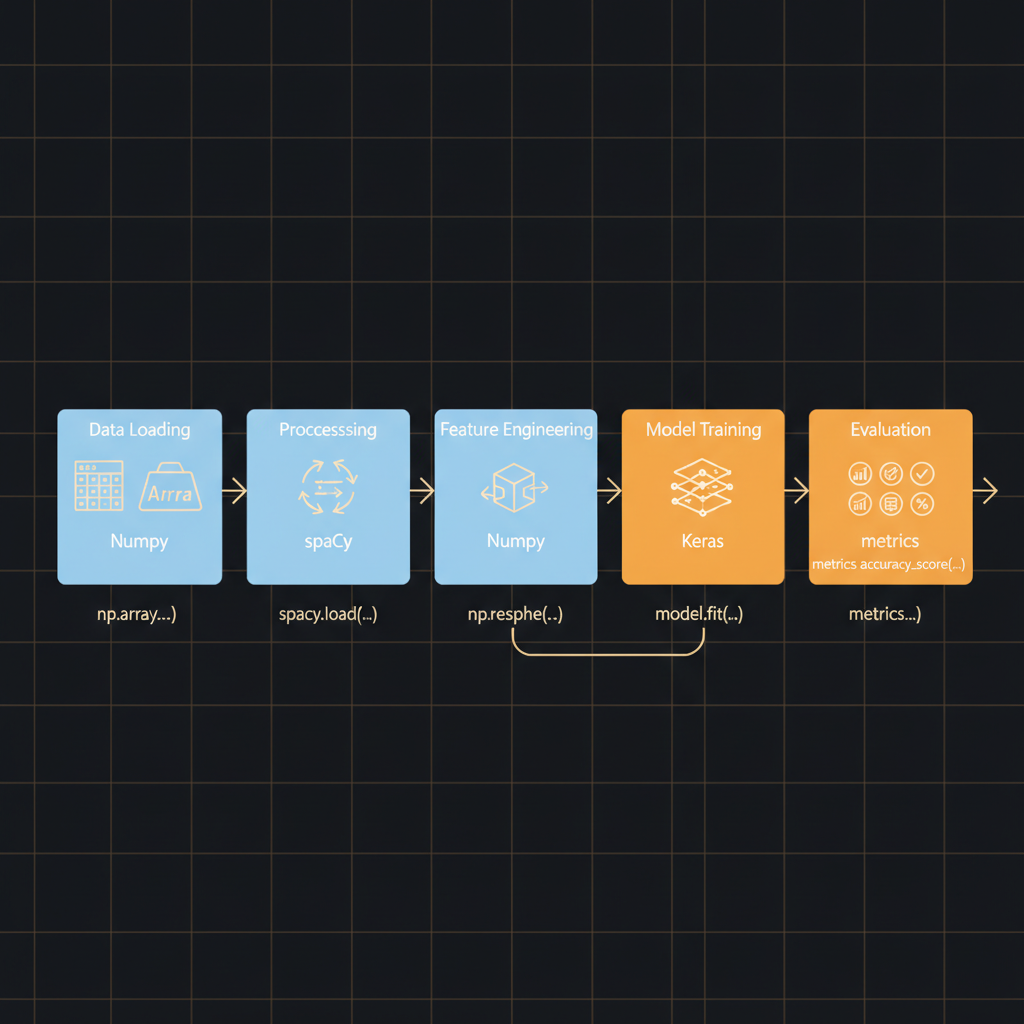
Architecture diagram for Use Python packages (spaCy, NumPy, Keras, etc.) to implement specific traditional machine learning analyses.. The traditional machine learning workflow using Python packages. Display sequential boxes connected by arrows: Data Loading (NumPy arrays icon), Preprocessing (spaCy tokenization symbol), Feature Engineering (NumPy matrix transformation), Model Training (Keras neural network layers), and Evaluation (metrics output). Include package logos or names inside each box. Use a left-to-right horizontal layout with light blue boxes for data stages and orange boxes for model stages. Add small code snippet labels beneath each box showing representative function calls like np.array, spacy.load, model.fit. Include a feedback loop arrow from Evaluation back to Feature Engineering to show iterative refinement.
You'll be able to
- Apply spaCy, NumPy, Keras, and related Python packages to implement traditional machine learning workflows in production AI environments, consistent with NVIDIA certification requirements [^1][^3].
- Evaluate which Python package (spaCy for natural language processing, NumPy for numerical computation, Keras for neural network prototyping) best suits a given traditional machine learning analysis task, drawing on the capabilities outlined in NVIDIA study materials [^3][^5][^6].
- Create end-to-end machine learning pipelines that integrate multiple Python packages (e.g., spaCy for text preprocessing, NumPy for feature engineering, Keras for model training) to solve specific analytical problems aligned with NVIDIA's deep learning and data science curricula [^3][^4].
- Leverage transfer learning techniques and common deep learning data types within Python frameworks to achieve efficient results with less data and computation, as emphasized in NVIDIA's Fundamentals of Deep Learning course [^3].
- Classify data science problems by algorithm type (including XGBoost and graph algorithms) and select appropriate Python tooling to address them, reflecting the breadth of machine learning methods covered in NVIDIA's Fundamentals of Accelerated Data Science training [^3].
Key concepts · tap to reveal
1/23·Idea
0%
Idea
01 / 23
Why Python packages matter in production ML
You're debugging a sentiment classifier that's drifting in production. The model worked in staging, but now customer support is flagging misrouted tickets because your preprocessing pipeline silently changed when a dependency auto-updated. Your manager wants root cause by end of day, and you realize you've been calling spaCy tokenization, NumPy array reshaping, and Keras prediction layers without fully understanding where each package hands off to the next[^3]. The NVIDIA certification exam expects you to implement traditional machine learning workflows with these libraries not just by copying Stack Overflow snippets, but by knowing which tool solves which part of the pipeline and how they connect[^1][^2].
Your task Write a prompt that asks Claude to recommend the right AI setup for a real task you're facing — then weigh its answer against this lesson, "Use Python packages (spaCy, NumPy, Keras, etc.) to implement specific traditional machine learning analyses.."
a strong prompt:role · context · task · format · example
Exercise · scenario
## Scenario **Difficulty Level:** Applied Your team is building a sentiment-analysis pipeline for customer feedback on an NVIDIA-based AI product. The project lead has asked you to prototype a traditional machine learning classifier that tokenizes text, extracts numerical features, and trains a shallow **neural network** before the team commits to a full transformer-based approach[^1][^3]. You have **spaCy** installed for natural language processing tasks, **NumPy** for array operations, and **Keras** for model construction[^1][^3]. The lead wants you to demonstrate that you can implement the end-to-end workflow using these packages to establish a performance baseline, then justify whether this traditional ML approach is sufficient or whether the team should invest in fine-tuning a pre-trained encoder model for semantic analysis[^3]. **What would you do, and why?**
Deliverable
You will produce a **Traditional ML Pipeline Notebook** that implements at least three distinct machine learning analyses using the Python packages named in the exam objective (**spaCy**, **NumPy**, **Keras**, or similar libraries)[^1][^3]. The notebook must demonstrate end-to-end workflows: data preprocessing with NumPy or spaCy, model training with Keras or another framework, and evaluation with metrics computed in code.
Practice · Scenarios
0 of 8 revealed
Scenario 1 of 8
A legal tech startup is building a contract clause extraction system for employment agreements. They need to identify 15 specific clause types (non-compete, confidentiality, termination, etc.) from 500-page documents. The technical lead proposes using spaCy's dependency parsing to identify clause boundaries, training a Keras CNN model on clause embeddings for classification, and using NumPy to compute similarity matrices between extracted clauses and template language. They have 5,000 annotated contracts spanning 10 years.
Sources
- [1]NVIDIA-Certified Associate: Generative AI LLMs (NCA-GENL) Study Guide·NVIDIA-Certified Associate: Generative AI LLMs (NCA-GENL) Study Guide (2026) · Vendor
- [2]NVIDIA-Certified Associate: Generative AI Multimodal (NCA-GENM) Study Guide·NVIDIA-Certified Associate: Generative AI Multimodal (NCA-GENM) Study Guide (2026) · Vendor
- [3]OpenAlex API·OpenAlex API (2026) · Vendor
Submit your work for review
Paste your capstone artifact below. You'll get back a 4-level rubric grade, per-criterion feedback, and three concrete edits to strengthen it.