
0of21read0 XP

Build LLM use cases such as RAGs, chatbots, and summarizers.
Design a retrieval-augmented generation (RAG) pipeline that integrates external knowledge sources with a large language model to answer domain-specific questions[^1][^2].
- Time
- 20–25 min
- Type
- exercise
- Bloom
- Apply → Create
- XP
- 100
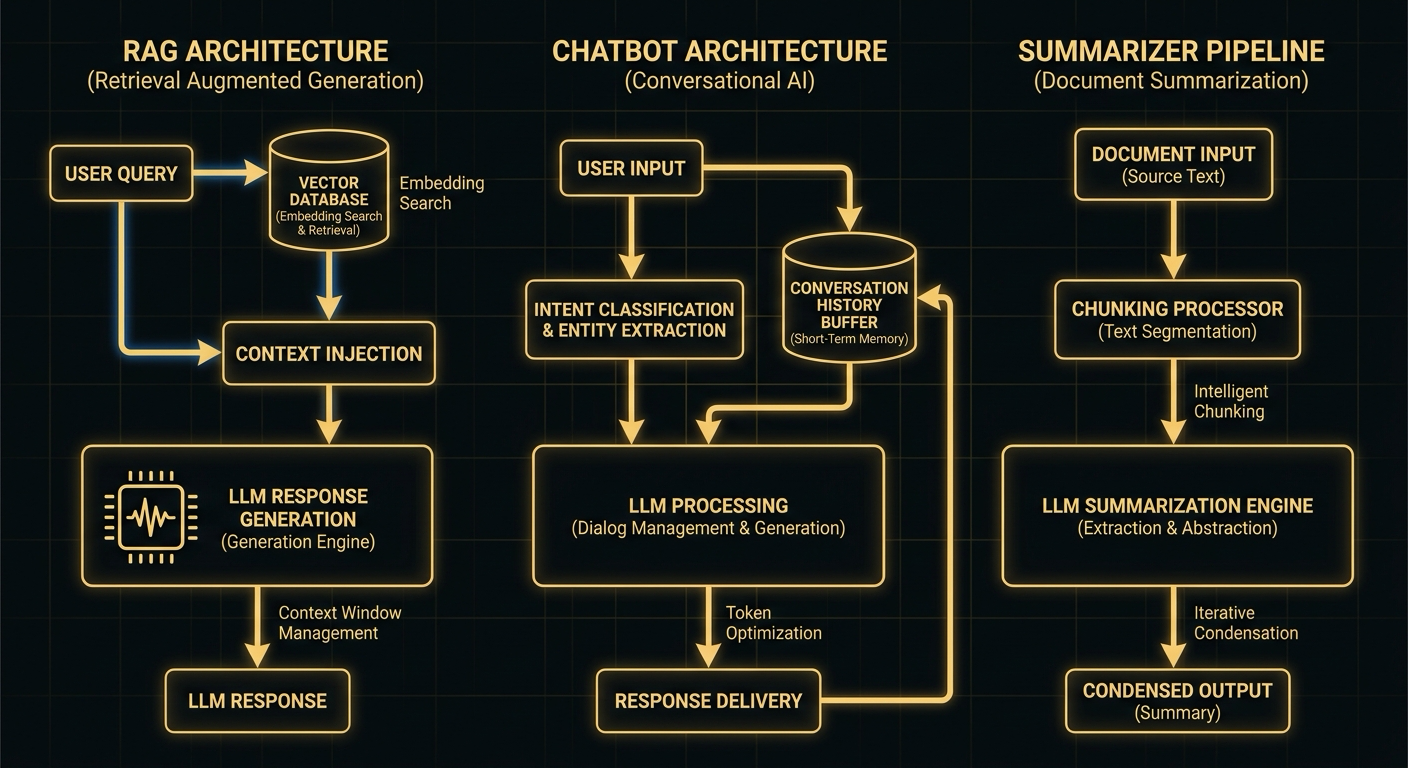
Architecture diagram for Build LLM use cases such as RAGs, chatbots, and summarizers.. Three parallel LLM use case architectures arranged horizontally. Left column depicts RAG (Retrieval Augmented Generation) with user query flowing through vector database retrieval, context injection, and LLM response generation. Middle column shows chatbot architecture with conversation history buffer, intent classification, LLM processing, and response delivery. Right column illustrates summarizer pipeline with document input, chunking processor, LLM summarization engine, and condensed output. Use blue for data flow arrows, orange boxes for LLM components, and green cylinders for storage elements. Label each architecture clearly with component names and include brief annotations for key operations like embedding search, context window management, and token optimization.
You'll be able to
- Design a retrieval-augmented generation (RAG) pipeline that integrates external knowledge sources with a large language model to answer domain-specific questions[^1][^2].
- Implement a conversational chatbot interface that maintains multi-turn dialogue context and responds appropriately to user queries using LLM capabilities[^1][^2].
- Create a text summarization workflow that condenses long-form documents into concise outputs while preserving key information and intent[^1][^2].
- Evaluate the accuracy, relevance, and user satisfaction of each use case implementation against task requirements and production quality standards[^1][^2].
- Apply context augmentation techniques to connect private or domain-specific data sources with LLM inference, ensuring the model can access information beyond its pre-training corpus[^1][^2].
Key concepts · tap to reveal
1/21·Idea
0%
Idea
01 / 21
The Production Reality Check
Your customer-support chatbot launches, and within 48 hours the VP asks why it can't answer questions about last quarter's product updates. The model is fluent but hallucinates policy details and invents procedures. Compliance flags three contradictions of documented vendor terms. The summarization feature still requires human rewrites. These aren't edge cases—they're predictable outcomes of treating a base LLM as a finished application. Production use cases require deliberate architectural choices: retrieval pipelines that ground responses in verified documents, conversational state management, and summarization logic tuned to stakeholder needs.
Your task Write a prompt that asks Claude to recommend the right AI setup for a real task you're facing — then weigh its answer against this lesson, "Build LLM use cases such as RAGs, chatbots, and summarizers.."
a strong prompt:role · context · task · format · example
Exercise · scenario
## Scenario **Difficulty Level:** Applied Your team has been asked to build a customer-support solution for a financial services firm that handles thousands of inquiries daily about account policies, transaction disputes, and regulatory compliance. The firm's knowledge base includes internal policy documents, regulatory filings, and historical case resolutions. Leadership wants a system that can answer questions accurately, cite sources for audit purposes, and escalate complex cases to human agents. They are debating three architectures: a pure **chatbot** trained on company data, a **retrieval-augmented generation** (**RAG**) system that pulls from indexed documents at query time, or a summarization pipeline that pre-digests policy documents into FAQ-style responses. The compliance officer insists that every answer must be traceable to a specific source document. The operations lead wants sub-second response times. The data science manager notes that policy documents change quarterly and retraining a model is expensive.
Deliverable
You will produce a **three-use-case implementation portfolio** as a single Markdown document that demonstrates your ability to build **retrieval-augmented generation** (**RAG**), **chatbot**, and **summarizer** applications [^1][^2]. The portfolio must include three distinct Python code modules (one per use case), each with inline comments explaining design choices, a requirements.txt file listing dependencies, and a brief architecture diagram (ASCII or embedded image) showing data flow from input through the LLM to output.
Practice · Scenarios
0 of 8 revealed
Scenario 1 of 8
A university's student services department wants to provide 24/7 support for common questions about enrollment deadlines, financial aid processes, housing applications, and campus policies. Students typically ask questions like 'How do I apply for work-study?' or 'What's the deadline for dropping classes?' The system should maintain conversation context across multiple turns, handle follow-up questions, and escalate complex cases to human advisors. The department has 200 FAQ documents and policy pages, and expects 50-100 concurrent student conversations during peak registration periods.
Quiz · adaptive · 3 items
Mastery check
Match each term to its definition. Pass at 80% to earn the lesson's XP and unlock the next.
Sources
- [1]NVIDIA-Certified Associate: Generative AI LLMs (NCA-GENL) Study Guide·NVIDIA-Certified Associate: Generative AI LLMs (NCA-GENL) Study Guide (2026) · Vendor
- [2]OpenAlex API·OpenAlex API (2026) · Research
- [3]LlamaIndex Documentation·LlamaIndex Documentation (2026) · Vendor
- [4]arXiv API·arXiv API (2026) · Research
- [5]arXiv API·arXiv API (2026) · Research
- [6]OpenAlex API·OpenAlex API (2026) · Vendor
Submit your work for review
Paste your capstone artifact below. You'll get back a 4-level rubric grade, per-criterion feedback, and three concrete edits to strengthen it.