
0of18read0 XP

Conduct data analysis under the supervision of a senior team member.
Apply structured data analysis workflows to generative AI experimentation tasks while documenting findings for senior review, as required by the NCA-GENL exam task 3.3[^2].
- Time
- 20–25 min
- Type
- exercise
- Bloom
- Apply → Evaluate
- XP
- 100
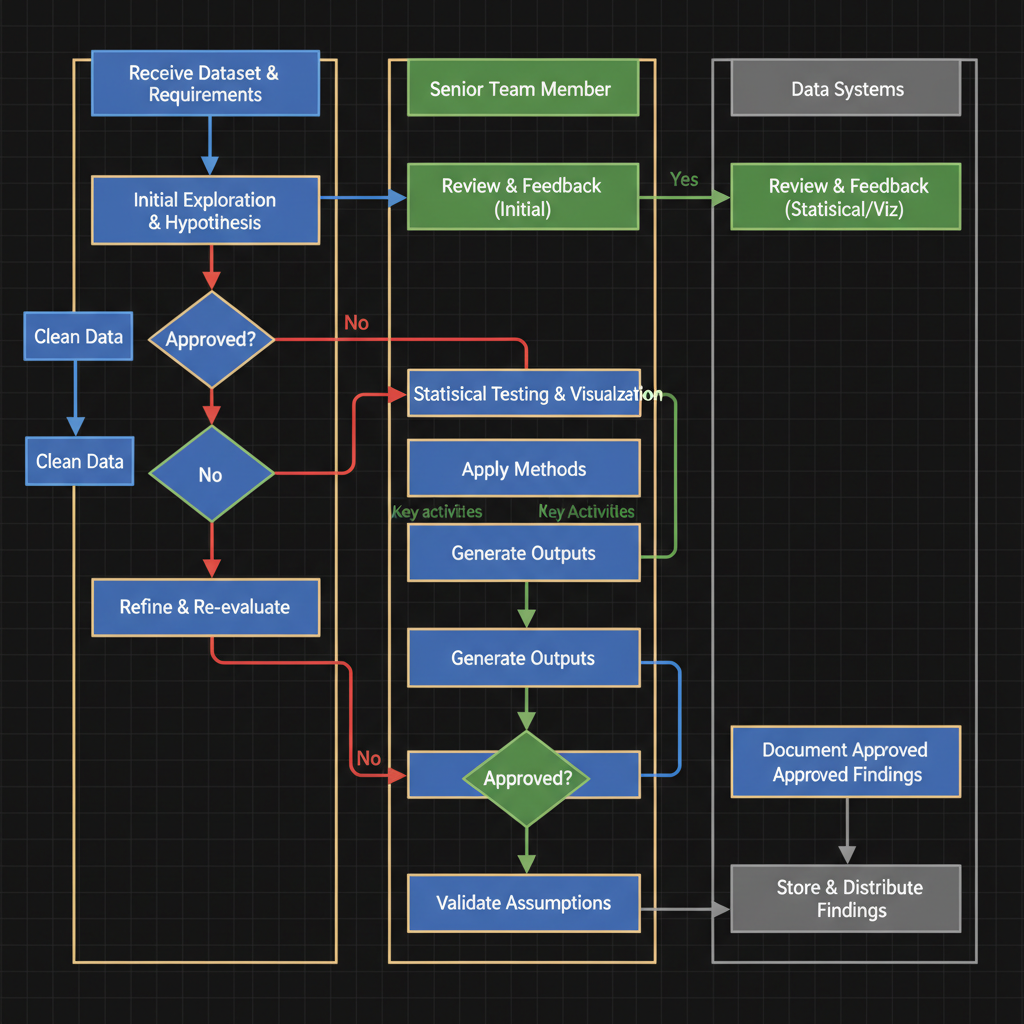
Architecture diagram for Conduct data analysis under the supervision of a senior team member.. The supervised data analysis workflow with three swim lanes: Junior Analyst (left), Senior Team Member (middle), and Data Systems (right). The flow begins with the junior analyst receiving a dataset and analysis requirements, moves through initial exploration and hypothesis formation with a checkpoint arrow to the senior for review and feedback, continues to statistical testing and visualization creation with another senior review checkpoint, then proceeds to interpretation of results with final senior validation, and ends with approved findings documentation. Use blue for junior analyst actions, green for senior oversight points, and gray for system interactions. Include decision diamonds at each review stage labeled "Approved?" with yes/no paths, where no loops back to refinement steps. Add labels for key activities: "Clean Data," "Apply Methods," "Generate Outputs," "Validate Assumptions."
You'll be able to
- Apply structured data analysis workflows to generative AI experimentation tasks while documenting findings for senior review, as required by the NCA-GENL exam task 3.3[^2].
- Evaluate the completeness and validity of analysis outputs (metrics, visualizations, statistical summaries) against project requirements before escalating results to senior team members[^2].
- Execute supervised data exploration and preprocessing steps for LLM training datasets, applying appropriate tools and techniques under guidance[^2].
- Document analysis methodologies, assumptions, and limitations in a format that enables senior practitioners to verify correctness and reproducibility[^2].
- Classify when to escalate ambiguous findings or technical blockers to senior supervision during the data analysis phase of generative AI projects[^2].
Key concepts · tap to reveal
1/18·Idea
0%
Idea
01 / 18
The supervised analysis scenario
You're three weeks into your first generative AI project when your team lead drops a Jupyter notebook on your desk and says, "Clean this dataset, run the embeddings analysis, and flag anything that looks off. I'll review your work before we present to the client Friday." The NVIDIA NCA-GENL exam expects you to handle exactly this scenario: conducting data analysis under supervision, a skill tested in both the Data Analysis and Experimentation domains. If you misinterpret the senior engineer's requirements or fail to document your analytical choices, the entire model pipeline downstream inherits your mistakes.
Your task Write a prompt that asks Claude to recommend the right AI setup for a real task you're facing — then weigh its answer against this lesson, "Conduct data analysis under the supervision of a senior team member.."
a strong prompt:role · context · task · format · example
Exercise · scenario
## Scenario **Difficulty Level:** Applied You are a junior machine learning engineer working on a generative AI project. Your team lead has asked you to analyze the training loss curves and validation **metrics** from an overnight fine-tuning run of a large language model. You notice several anomalies: the training loss plateaus after epoch 3, validation perplexity spikes at epoch 5, and GPU memory utilization logs show inconsistent patterns. Your lead is in back-to-back meetings for the next four hours. You could spend the morning investigating these patterns on your own, potentially identifying root causes, or you could wait to review your observations with your lead before proceeding. **What would you do, and why?** Consider how the NCA-GENL exam objective to conduct data analysis under the supervision of a senior team member[^1][^2] applies to this situation, what actions demonstrate appropriate professional judgment, and how you would document your findings for supervisory review.
Deliverable
You will produce a **Data Analysis Review Document** in Markdown format that demonstrates your ability to conduct data analysis under the supervision of a senior team member, as required by the NCA-GENL exam objective [^2]. The document must include: (1) a brief description of a generative AI dataset or experiment you analyzed (real or simulated), (2) the specific analytical questions or hypotheses you investigated, (3) the methods and tools you applied (Python libraries, statistical tests, visualization techniques), (4) your preliminary findings presented in tables or inline code snippets,…
Practice · Scenarios
0 of 8 revealed
Scenario 1 of 8
You are a junior data scientist at an automotive manufacturer analyzing sensor data from autonomous vehicle test drives. Your senior engineer asks you to examine 2TB of LiDAR and camera data to identify scenarios where the AI system showed degraded performance. You've written scripts to parse the data and identified 200 potential incidents. However, you realize that your initial filtering criteria might be too broad, potentially including false positives. You also notice the analysis is taking longer than the three-day timeline your senior mentioned. What approach best reflects proper conduct of analysis under supervision?
Sources
- [1]NVIDIA-Certified Associate: Generative AI LLMs (NCA-GENL) Study Guide·NVIDIA-Certified Associate: Generative AI LLMs (NCA-GENL) Study Guide (2026) · Vendor
- [2]NVIDIA-Certified Associate: Generative AI Multimodal (NCA-GENM) Study Guide·NVIDIA-Certified Associate: Generative AI Multimodal (NCA-GENM) Study Guide (2026) · Vendor
Submit your work for review
Paste your capstone artifact below. You'll get back a 4-level rubric grade, per-criterion feedback, and three concrete edits to strengthen it.