
0of17read0 XP

Conduct data analysis under the supervision of a senior team member.
Apply structured data analysis workflows to generative AI datasets while documenting decisions for senior review [^1][^2].
- Time
- 20–25 min
- Type
- exercise
- Bloom
- Understand → Create
- XP
- 100
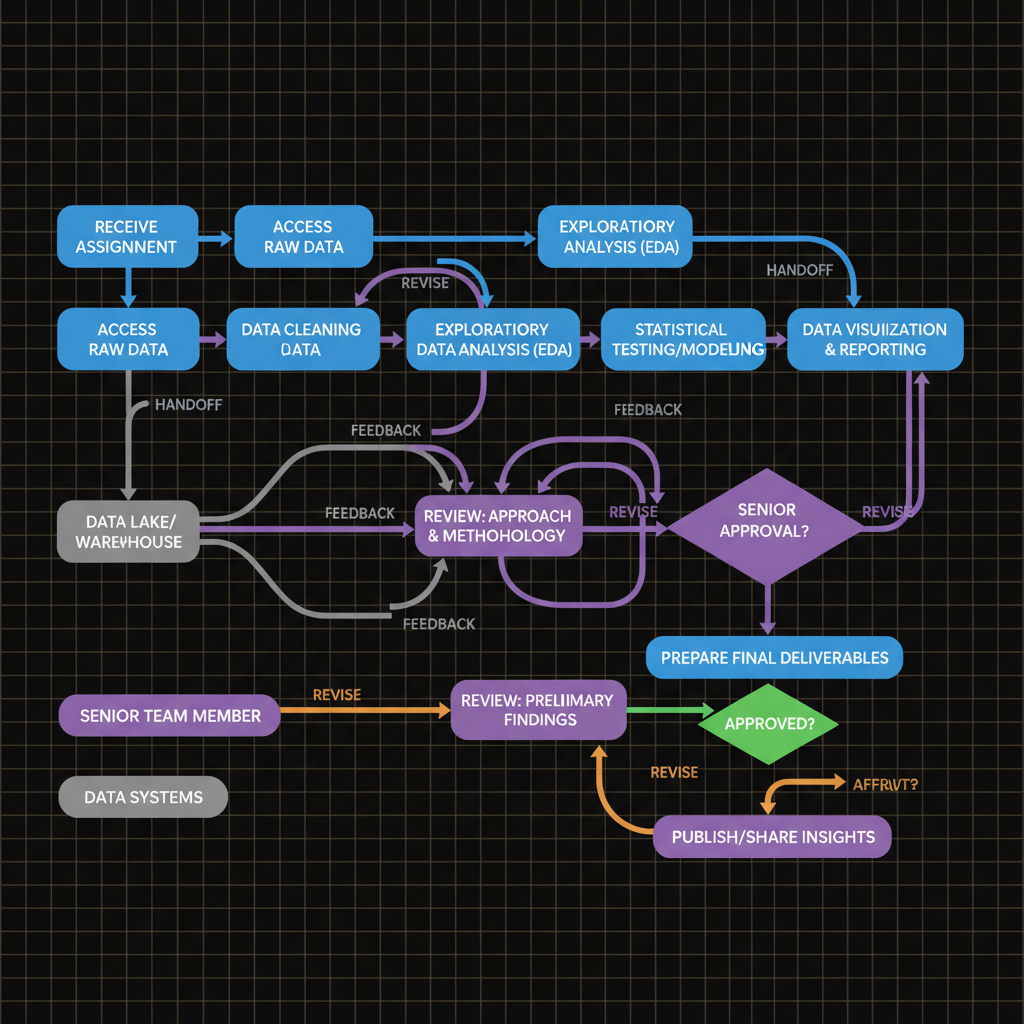
Architecture diagram for Conduct data analysis under the supervision of a senior team member.. The supervised data analysis workflow with three swim lanes: Junior Analyst, Senior Team Member, and Data Systems. The flow begins with the junior analyst receiving assignment and accessing data, followed by parallel review checkpoints where the senior member validates approach, methodology, and preliminary findings. Include decision diamonds for senior approval gates (green for approved, amber for revise), feedback loops returning to earlier steps, and final output validation. Show data flowing from systems through cleaning, exploratory analysis, statistical testing, and visualization stages. Label key handoff points between junior and senior roles, emphasizing iterative collaboration. Use blue for junior tasks, purple for senior oversight, and gray for system components in a left-to-right progression.
You'll be able to
- Apply structured data analysis workflows to generative AI datasets while documenting decisions for senior review [^1][^2].
- Evaluate the completeness and quality of analysis outputs against project requirements before escalating findings to senior team members [^1][^2].
- Classify data anomalies, distribution characteristics, and preprocessing needs in LLM training or inference datasets under guided supervision [^1][^2].
- Create reproducible analysis scripts and visualizations that communicate data insights to senior stakeholders in production AI contexts [^1][^2].
- Explain the rationale behind chosen analytical methods and their alignment with project objectives when presenting results to supervising engineers [^1][^2].
Key concepts · tap to reveal
1/17·Idea
0%
Idea
01 / 17
The Real-World Stakes of Supervised Analysis
You're three weeks into your first AI engineering role when your team lead drops a Jupyter notebook on your desk: 40,000 rows of training metrics from last night's LLM fine-tuning run, loss curves that flatlined after epoch two, and a terse Slack message asking you to "dig in and report back by end of day." The NVIDIA certification exam calls this "conducting data analysis under the supervision of a senior team member," but right now it feels more like being handed the keys to a production pipeline you barely understand. One wrong interpretation of those validation scores could send your team down a week-long debugging rabbit hole or, worse, into production with a model that hallucinates on edge cases.
Your task Write a prompt that asks Claude to recommend the right AI setup for a real task you're facing — then weigh its answer against this lesson, "Conduct data analysis under the supervision of a senior team member.."
a strong prompt:role · context · task · format · example
Exercise · scenario
## Scenario (Applied) You are a junior machine learning engineer on an LLM fine-tuning project. Your senior colleague has asked you to analyze token-level perplexity scores across three candidate checkpoints and prepare a summary of which checkpoint exhibits the lowest average perplexity on the validation set. Midway through your analysis, you notice that one checkpoint shows anomalously low perplexity on a subset of prompts that closely resemble the training data, suggesting possible overfitting. Your senior is in back-to-back meetings for the next two hours, and the project manager has requested your summary by end of day to inform a deployment decision. You have not yet discussed your overfitting hypothesis with your senior colleague, and you are uncertain whether the pattern you observed is statistically significant or a known artifact of the training procedure. **What would you do, and why?** [^1][^2]
Deliverable
You will produce a **Data Analysis Review Document** in Markdown format that demonstrates your ability to conduct data analysis under the supervision of a senior team member, as specified in the NCA-GENL exam objectives[^1]. The document must include: (1) a brief description of a generative AI dataset or model output you analyzed (e.g., token distributions, embedding quality metrics, or inference latency logs), (2) the specific analytical methods or scripts you applied, (3) a summary of findings written in plain language suitable for review by a senior engineer, (4) at least two questions or…
Practice · Scenarios
0 of 8 revealed
Scenario 1 of 8
You are a junior financial analyst at an investment firm analyzing quarterly earnings data for technology sector companies. Your senior team member has assigned you to identify correlations between R&D spending and revenue growth across 200 companies over five years. Midway through your analysis, you realize that three different data sources use inconsistent definitions of 'R&D spending'—one includes capital expenditures, another excludes contractor costs, and a third uses GAAP definitions. Your deadline is in two days, and reconciling these definitions would require significant additional time.
Sources
- [1]NVIDIA-Certified Associate: Generative AI LLMs (NCA-GENL) Study Guide·NVIDIA-Certified Associate: Generative AI LLMs (NCA-GENL) Study Guide (2026) · Vendor
- [2]NVIDIA-Certified Associate: Generative AI Multimodal (NCA-GENM) Study Guide·NVIDIA-Certified Associate: Generative AI Multimodal (NCA-GENM) Study Guide (2026) · Vendor
Submit your work for review
Paste your capstone artifact below. You'll get back a 4-level rubric grade, per-criterion feedback, and three concrete edits to strengthen it.