
0of19read0 XP

Describe how to use NVIDIA and other technologies to improve AI trustworthiness.
Explain the core technologies and methods NVIDIA recommends for improving AI trustworthiness, referencing official exam task 5.3[^1] and related training resources on content authenticity and trustworthy model development[^3].
- Time
- 20–25 min
- Type
- exercise
- Bloom
- Understand → Create
- XP
- 100
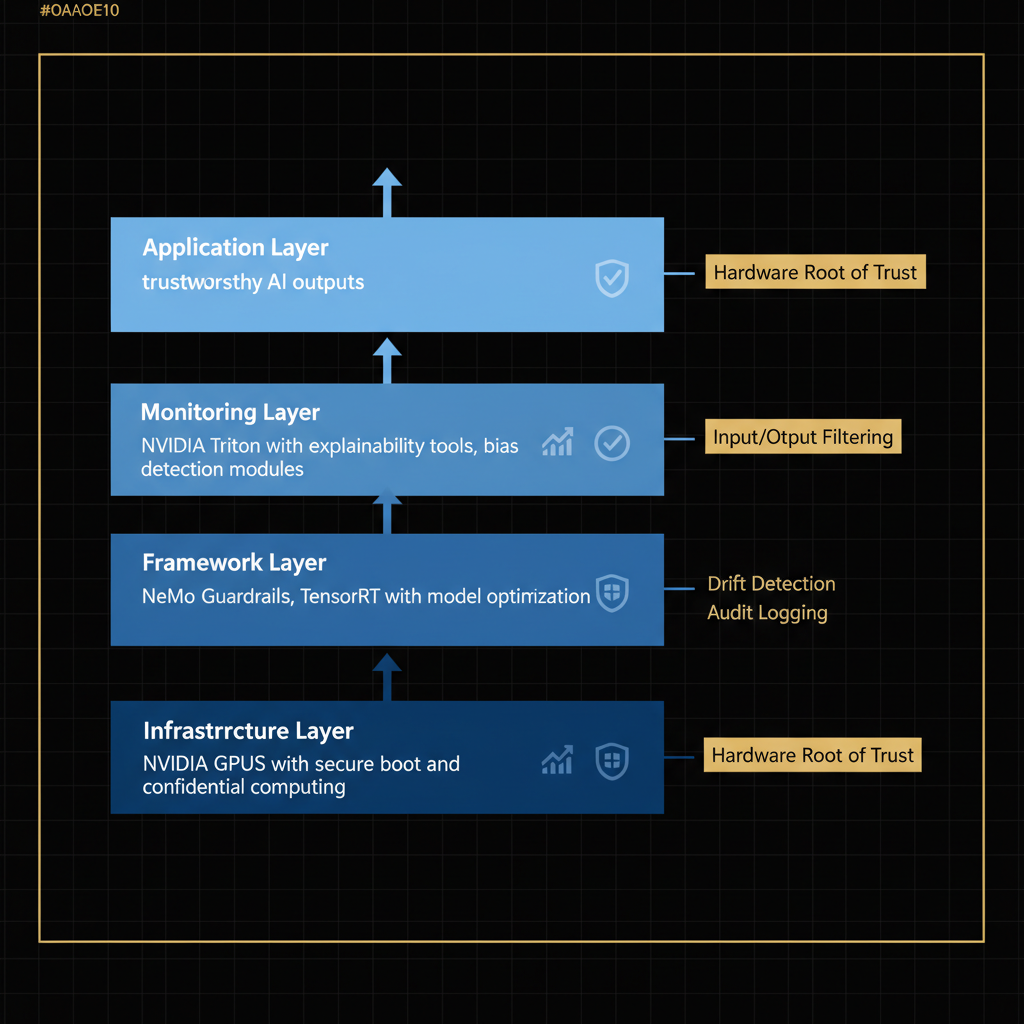
Architecture diagram for Describe how to use NVIDIA and other technologies to improve AI trustworthiness.. AI trustworthiness technology stack. Display four horizontal layers from bottom to top: Infrastructure Layer (NVIDIA GPUs with secure boot and confidential computing), Framework Layer (NeMo Guardrails, TensorRT with model optimization), Monitoring Layer (NVIDIA Triton with explainability tools, bias detection modules), and Application Layer (trustworthy AI outputs). Use arrows flowing upward to show data progression. Include side annotations for key capabilities at each layer: hardware root of trust, input/output filtering, drift detection, and audit logging. Color code layers in blue gradient from dark (infrastructure) to light (application). Add small icons representing security shields, validation checkmarks, and monitoring graphs at relevant layers to emphasize trust mechanisms.
You'll be able to
- Explain the core technologies and methods NVIDIA recommends for improving AI trustworthiness, referencing official exam task 5.3[^1] and related training resources on content authenticity and trustworthy model development[^3].
- Classify trustworthy AI techniques by their application domain (e.g., bias mitigation, retrieval-augmented generation, guardrails), drawing on NVIDIA's published guidance on trustworthy AI principles and RAG architectures[^3][^4].
- Apply NVIDIA and industry-standard tools to evaluate the trustworthiness of a generative AI system, selecting appropriate methods for content authenticity, bias detection, and safe deployment[^3][^4].
- Evaluate a deployed AI solution against trustworthiness criteria, identifying gaps and recommending specific NVIDIA or complementary technologies to address those gaps in alignment with exam objective 5.3[^1].
- Create a trustworthiness improvement plan for a generative AI application, integrating NVIDIA training recommendations and suggested readings on trustworthy AI practices[^3][^4].
Key concepts · tap to reveal
1/19·Idea
0%
Idea
01 / 19
AI Trustworthiness as Operational Reliability
AI trustworthiness is the degree to which a deployed system behaves reliably, fairly, and transparently in real-world conditions. Like a bridge that engineers verify for load capacity and document for maintenance, a trustworthy AI system must demonstrate accurate outputs, equitable treatment across user groups, and explainable decisions. Generative AI introduces unique challenges: models can fabricate plausible facts, amplify training biases, or violate safety guidelines. The NVIDIA certification requires you to describe specific tools and practices that make AI systems dependable in production.
Your task Write a prompt that asks Claude to recommend the right AI setup for a real task you're facing — then weigh its answer against this lesson, "Describe how to use NVIDIA and other technologies to improve AI trustworthiness.."
a strong prompt:role · context · task · format · example
Exercise · scenario
## Scenario **Difficulty Level:** Applied Your team has deployed a customer-service chatbot that generates product recommendations for an e-commerce platform. During the first week of production, the security lead notices that users can manipulate prompts to extract internal pricing logic, and the QA team flags that certain demographic groups receive consistently lower-value product suggestions. Leadership wants the system to remain live while you address trustworthiness concerns. The NVIDIA certification study materials emphasize that practitioners should know how to apply technologies and frameworks to improve AI trustworthiness in production contexts[^1][^2], and related guidance points to resources on building trustworthy models and minimizing bias[^3][^4]. **What would you do, and why?** Which NVIDIA or industry technologies would you prioritize to address the prompt-injection risk and the demographic disparity, and how would you justify keeping the system online (or taking it offline) while implementing those controls?
Deliverable
To demonstrate your ability to apply **trustworthy AI** technologies in an NVIDIA-aligned production context, you will produce a **Trustworthy AI Implementation Plan** as a structured Markdown document[^1][^2]. This artifact specifies a concrete **generative AI** system (for example, a customer-service chatbot or a content-generation pipeline), then documents which NVIDIA and complementary technologies you will deploy to address each pillar of trustworthiness: explainability, fairness, robustness, privacy, and safety.
Practice · Scenarios
0 of 8 revealed
Scenario 1 of 8
An e-commerce platform is deploying a multimodal AI system that generates product descriptions from images and structured attribute data. The legal team has raised concerns about potential copyright infringement, as the model occasionally generates descriptions that closely paraphrase copyrighted marketing materials from competitor websites that appeared in the training data. The system processes 50,000 new product listings weekly across 12 international markets. The engineering lead needs to implement a solution that reduces the risk of generating protected content while maintaining description quality and supporting multiple languages. The team wants to avoid complete model retraining due to time and cost constraints.
Quiz · adaptive · 3 items
Mastery check
Match each term to its definition. Pass at 80% to earn the lesson's XP and unlock the next.
Sources
- [1]NVIDIA-Certified Associate: Generative AI LLMs (NCA-GENL) Study Guide·NVIDIA-Certified Associate: Generative AI LLMs (NCA-GENL) Study Guide (2026) · Vendor
- [2]NVIDIA-Certified Associate: Generative AI Multimodal (NCA-GENM) Study Guide·NVIDIA-Certified Associate: Generative AI Multimodal (NCA-GENM) Study Guide (2026) · Vendor
- [3]NVIDIA Developer Blog·NVIDIA Developer Blog (2026) · Vendor
Submit your work for review
Paste your capstone artifact below. You'll get back a 4-level rubric grade, per-criterion feedback, and three concrete edits to strengthen it.