
0of16read0 XP

The One Big Decision
Name the one choice this unit is about — the mix of stocks and bonds — and explain why how much you put in or take out is a separate decision made next time
- Time
- 20–25 min
- Type
- exercise
- Bloom
- Understand → Understand
- XP
- 100
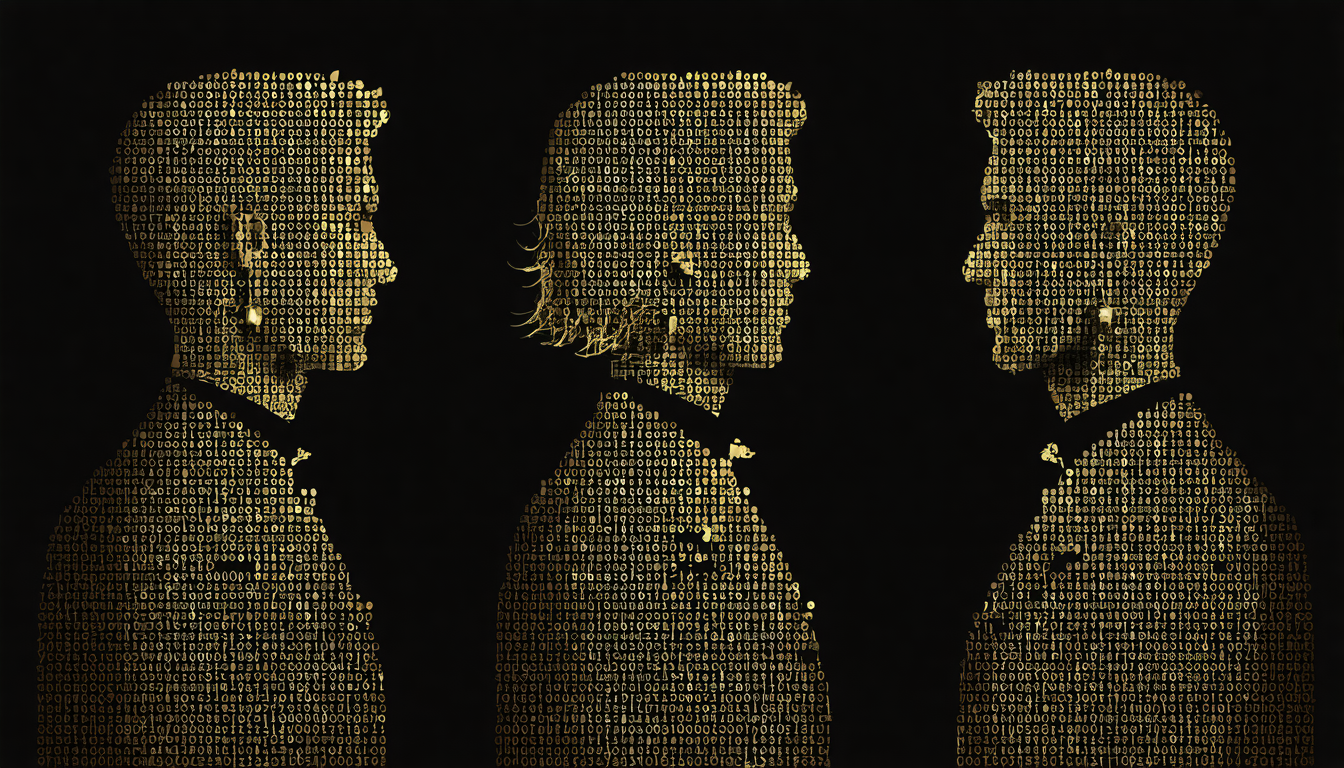
Architecture diagram for The One Big Decision. Three side-by-side 100-person icon arrays on a dark background, gold-on-near-black. Each array is a 10x10 grid of human silhouette icons. Array headers in large bold gold text: left 'Mix A — 20% Stocks / 80% Bonds', center 'Mix B — 60% Stocks / 40% Bonds', right 'Mix C — 80% Stocks / 20% Bonds'. Icons are color-coded by outcome: solid fill for balance sustained, diagonal-hatch for reduced balance, dotted outline for depleted. Mix A has the tightest cluster — most icons solid, narrow spread bracket on the left side labeled 'spread of outcomes', median arrow pointing to the solid band labeled 'most common outcome'. Mix B has a moderate spread, wider bracket, median arrow slightly higher. Mix C has the widest spread bracket stretching to both the strong-balance top and the depleted-balance bottom, median arrow at the highest position of the three, but the full range of solid-to-dotted icons visible. Below each grid: a plain-text shaded caption box in gold describing the tradeoff (e.g. 'Steadiest balance — may not keep up with rising prices').
You'll be able to
- Name the one choice this unit is about — the mix of stocks and bonds — and explain why how much you put in or take out is a separate decision made next time
- Read each of the three mixes in plain dollar terms on a round $10,000 example and describe its tradeoff: what it gives you and what it gives up [^1]
- Explain what the 100-person picture shows — not a survey of other people, not a guarantee, but one possible future for you, replayed 100 times — and read the spread and the middle of the pack across all three mixes [^1] [^2]
Key concepts · tap to reveal
1/16·Watch·Beat 1 · Hook
0%
Hook
The question is not how hard you worked — it is how your savings is mixed
Your task Write a prompt that asks Claude to recommend the right AI setup for a real task you're facing — then weigh its answer against this lesson, "The One Big Decision."
a strong prompt:role · context · task · format · example
Exercise · scenario
# Scenario — Tracing a Choice Through the Picture Let's walk through a real-world scenario so you can see the tradeoffs working in actual dollar terms. --- ## Scenario: The Very Steady Saver You want a balance that never surprises you — close to the same path each year, no shocks. So you choose Mix A: about 20% stocks and 80% bonds (roughly $2,000 in stocks and $8,000 in bonds for every $10,000). For the first ten years, Mix A does exactly what you wanted. Your balance is steady. Your statement does not show frightening drops. You feel secure. But in year fifteen, you notice that everyday costs have quietly climbed. Your savings cover what they always covered — on paper. In practice, the same dollars buy noticeably less. Your pile grew slower than rising prices. The bond-heavy mix ran steady but not fast enough to keep up. **What the 100-person picture would have told you:** Most of the 100 little people in Mix A's picture are doing okay — but the ones near the bottom of the spread show this exact pattern: the balance held steady in dollar terms, but rising prices slowly outran the pile's growth.
Deliverable
Close the lesson. Without looking back at any section, answer the following three prompts in your own words. Write your answers down. **Prompt 1:** Describe Mix A in one or two sentences. What does it give, and what does it give up? Try to include at least one dollar figure from the $10,000 examples. **Prompt 2:** Describe Mix C in one or two sentences. What does it give, and what does it give up? Again, try to use a dollar figure. **Prompt 3:** What does each little person in the 100-person picture represent? Give a one-sentence answer.
Practice · Scenarios
0 of 8 revealed
Scenario 1 of 8
Someone sees the 100-person icon array and says, 'So this is a poll of what happened to 100 other people like me?' How should they correct their understanding?
Sources
- [1]Unknown source·Unknown source (2026) · Vendor
Submit your work for review
Paste your capstone artifact below. You'll get back a 4-level rubric grade, per-criterion feedback, and three concrete edits to strengthen it.