
0of16read0 XP

Read Your Statement
Calculate 1% of your account balance in dollars, then divide by 12 to see what 1% costs or earns every month — turning any percentage on your statement into a real monthly figure you recognize
- Time
- 20–25 min
- Type
- exercise
- Bloom
- Understand → Understand
- XP
- 100
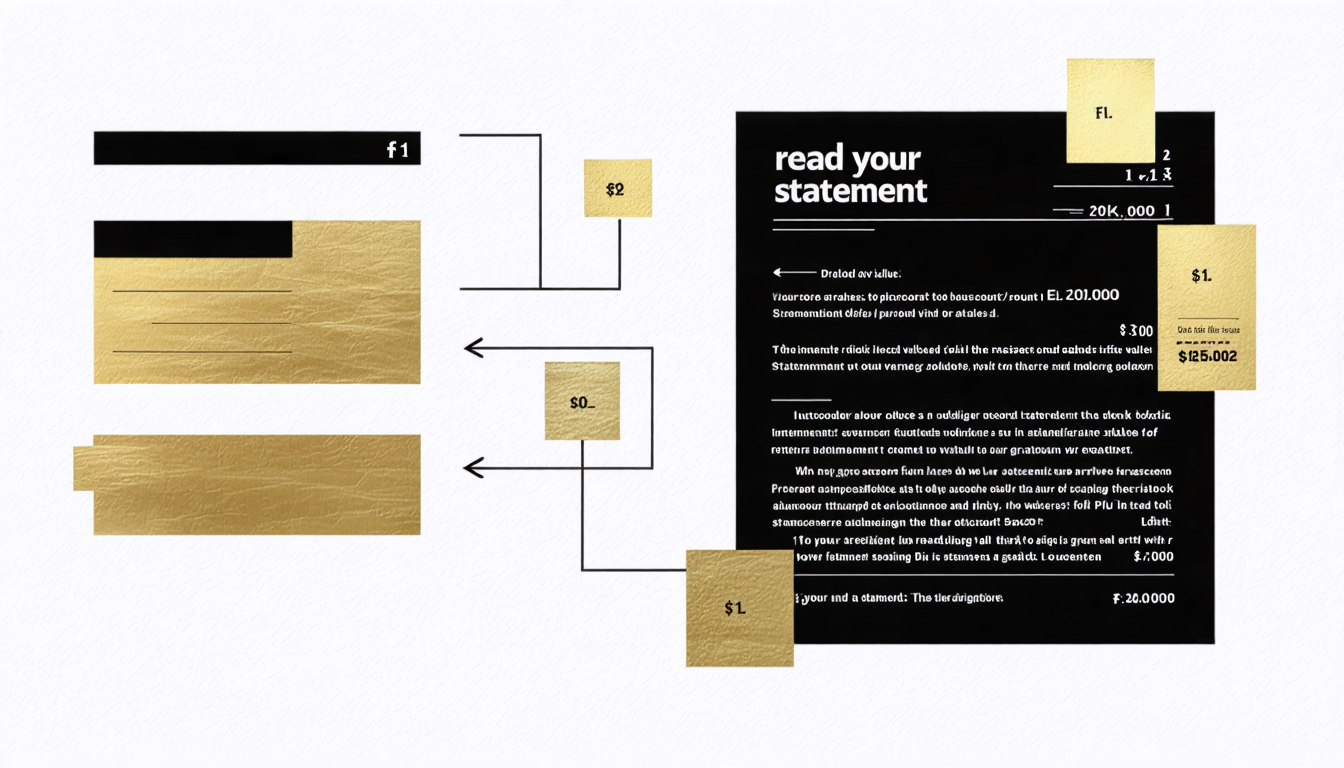
Architecture diagram for Read Your Statement. Dark near-black background, gold-on-black annotated statement diagram. Full-page layout showing a representative account statement with all interior dollar values replaced by round placeholder figures (e.g., a $10,000 balance). Five numbered callout boxes in gold, each with an arrow pointing to the relevant region of the statement. F1 (top summary area): arrow to the total account value line; label reads 'F1 — Your Total Value. Cross off two zeros = 1% per year. For every $10,000, 1% = $100/yr ≈ $8/mo.' F2 (holdings list, middle): arrow to the first fund line; label reads 'F2 — What You Own: Fund (basket) · Stock (one company) · Bond (loan you made) · Cash (parking spot).' F3 (total value line, second callout): label reads 'F3 — This moves. A drop is a price change, not a theft. Only permanent if you sell.' F4 (three callouts on institution header): F4a arrow to company logo — 'Custodian: holds it for you'; F4b arrow to account number — 'Your Account: the container'; F4c arrow to phone number with a hand-drawn gold circle — 'ONLY number you call.' F5 (account type label): arrow — 'F5 — Your Tax Bucket: IRA = tax later. Taxable = tax already paid on what went in.' Keep every figure as a round, relatable dollar amount that works for any saver — no assumed wealth or large headline balances.
You'll be able to
- Calculate 1% of your account balance in dollars, then divide by 12 to see what 1% costs or earns every month — turning any percentage on your statement into a real monthly figure you recognize
- Name and describe the four types of investment you might see on your statement — fund (a basket of hundreds of companies), stock (one company), bond (a loan you made), and cash (the parking spot) — in plain everyday language
- Explain why a drop in your balance is not theft, not fraud, and not a permanent loss — it's a price change on things you still own — and state the one condition under which a drop does become permanent: selling while the price is down
- Identify the three layers on your statement — custodian (who holds it), account (your container), and investments (what's inside) — and recite the one-number rule: call only the phone number circled on your own statement, never a number from an email or an unsolicited caller
- State which tax bucket your account is in — IRA (tax later, you got a discount going in) or regular taxable account (tax already paid on what went in) — and what that means when you take money out
Key concepts · tap to reveal
1/16·Watch·Beat 1 · Hook
0%
Hook
A piece of paper describes money that belongs to you — but it was written in a language you were never taught.
Your task Write a prompt that asks Claude to recommend the right AI setup for a real task you're facing — then weigh its answer against this lesson, "Read Your Statement."
a strong prompt:role · context · task · format · example
Exercise · scenario
# Scenario — Three Things That Feel Wrong But Are Not Here are three moments that come up when someone starts reading their own statement for the first time, and what to do in each one. **Moment 1: 'The number is lower than last month. Did something go wrong?'** You open the statement. The total value is lower than last month. Your first instinct is to call someone. Before you do: look at the date on the statement. Was the market down last month? If yes — and you can check this with a single search for 'S&P 500 last month' — then what you are seeing is your funds' prices following the market. The house is still there. The price changed. You still own the same things you owned last month. Nothing has been taken. The only question is whether to call the custodian's number you circled — and the answer is yes, if you feel uncertain. That is exactly what that number is for. **Moment 2: 'I don't recognize one of the lines in the holdings list.'** You see a line on your statement with a name you have never heard of. You do not know if it is a fund, a stock, or something else. This is not a problem — it is an opportunity to use what you now know.
Deliverable
Put the worksheet face-down. Pick up your statement. Starting anywhere you like, walk through what you see — out loud, in your own words, as if you were teaching it to someone else. Do not look anything up unless you get stuck. Work at your own pace; let yourself point and talk through each line rather than rushing. As you go, check silently whether you have covered each station: - **F1:** Did you point to the total value and explain what a percentage means in dollars? - **F2:** Did you name at least one holding type and say what it is in plain language?
Practice · Scenarios
0 of 8 revealed
Scenario 1 of 8
Your statement arrives in the mail. The total balance is several percent lower than last month. Your first thought is, 'Someone took it — or something went wrong with the account.' What is the most accurate response?
Sources
- [1]Unknown source·Unknown source (2026) · Vendor
Submit your work for review
Paste your capstone artifact below. You'll get back a 4-level rubric grade, per-criterion feedback, and three concrete edits to strengthen it.