
0of16read0 XP

What You Own and What It Costs
State an investment fee in real dollars — not as a percentage — and name how many of your monthly paychecks it equals
- Time
- 20–25 min
- Type
- exercise
- Bloom
- Understand → Understand
- XP
- 100
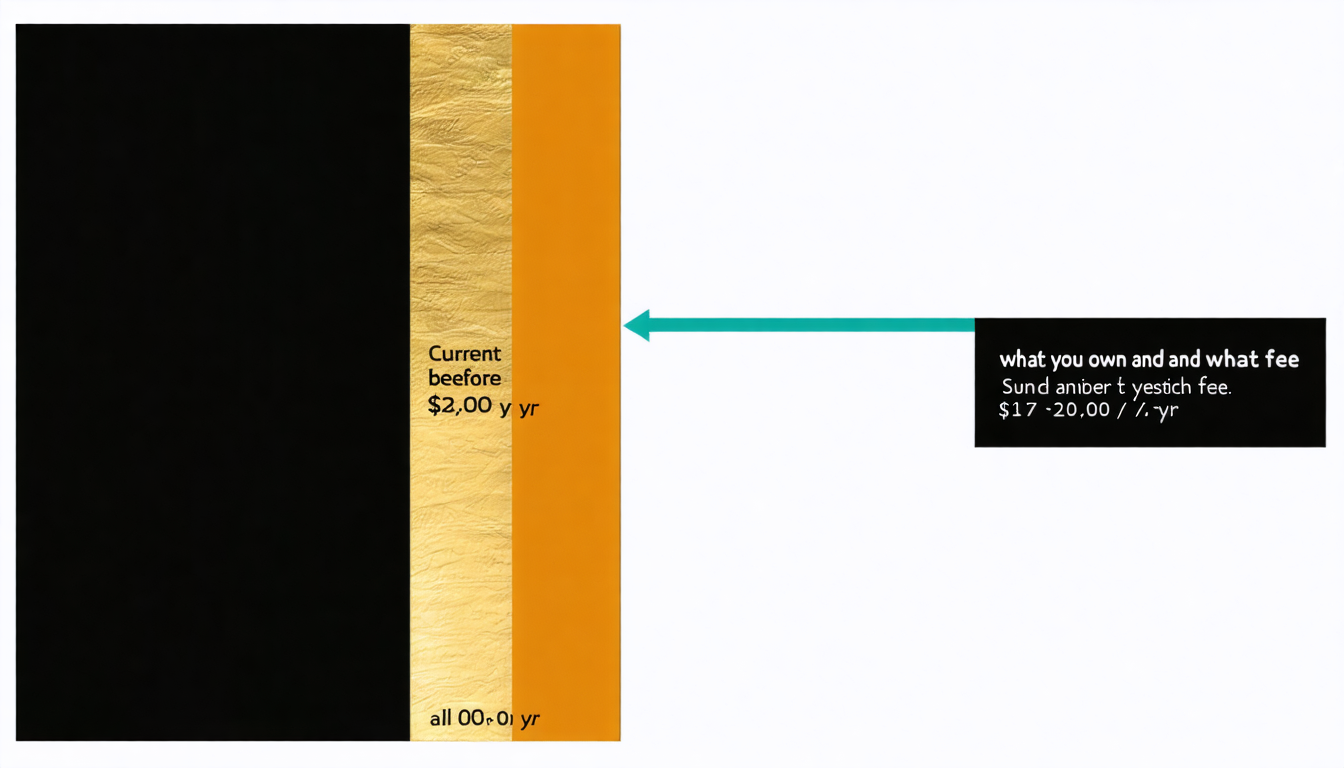
Architecture diagram for What You Own and What It Costs. Dark-background SVG, gold-on-near-black. Worked on a round $10,000 account so the math reads at a glance. Two stacked vertical bars, left column labeled 'Current (Before Switch)': top bar (amber) labeled 'ADVISOR FEE $100/yr' and bottom bar (teal) labeled 'FUND FEE (fund's yearly fee) $60/yr'; a right-side bracket spans both bars captioned 'ALL-IN: $160/yr — EVERY YEAR'. Right column labeled 'After Switch': top bar (amber, same height) 'ADVISOR FEE $100/yr'; bottom bar (teal, dramatically shorter) 'FUND FEE $5/yr'; right-side bracket captioned 'ALL-IN: $105/yr'. Between the two columns, a bold arrow pointing right with text '$55/yr captured on fund fees alone — per $10,000 held'. Below both columns in all-caps white bold: 'TWO FEES. STACKED. EVERY YEAR.' Small footnote: 'Same math at any balance — ×10 the balance, ×10 the dollars.' No photographic faces.
You'll be able to
- State an advisor's annual fee in real dollars — not as a percentage — and name how many monthly paychecks it equals
- Explain what the expense ratio is — the fund's own internal yearly charge, deducted quietly inside the fund before the price you see each day is calculated — and calculate its dollar cost on a given balance
- Add the two fees together and state why they stack instead of replacing each other, using the phrase 'Two fees. Stacked. Every year.'
- Explain in plain language why the cheaper fund is not the worse fund, using the contrast case of two identical funds where the only difference is the yearly fee
- Calculate the annual fee capture from switching to index funds and trace where each piece of savings comes from
Key concepts · tap to reveal
1/16·Watch·Beat 1 · Hook
0%
Hook
Turn the percentage on your statement into real dollars
Your task Write a prompt that asks Claude to recommend the right AI setup for a real task you're facing — then weigh its answer against this lesson, "What You Own and What It Costs."
a strong prompt:role · context · task · format · example
Exercise · scenario
# Scenario — Reading Someone Else's Statement A friend shows you their statement. They are proud: "My fund only costs 0.20% — that's practically nothing." Their advisor fee is 1% per year on a $50,000 account. You know two things they might not: **First:** What is the all-in cost, actually? The advisor fee is 1% × $50,000 = $500/yr. The fund's yearly fee is 0.20% × $50,000 = $100/yr. The all-in cost is $500 + $100 = **$600/yr** — two fees, stacked. They are only seeing the smaller of the two. **Second:** Is a 0.20% fund's yearly fee a signal that the fund is worse? No — and here is how you explain it without jargon: the fee is what the fund keeps from you before you see your return. A lower fee means more of the market's return flows to you. A higher fee means more of it goes to the fund company. The research says that over any 10-year period, the fee level predicts fund performance better than the star rating, the manager's track record, or the size of the fund. [^2] [^3] Three things to notice: (1) they are counting only one fee; (2) they think a low fund fee means a lower-quality fund; (3) they do not know what the stack totals.
Deliverable
Pull out any statement — yours, or one you can borrow. Fill in these five fields in writing: **Field A — The advisor fee in dollars:** $____________/yr (Calculation: advisor fee percentage × the total balance = _______) **Field B — The fund's yearly fee in dollars:** $____________/yr (Calculation: the fund's yearly fee percentage × the balance = _______) **Field C — All-in cost (A + B):** $____________/yr **Field D — All-in cost in monthly paychecks:** ____________ paychecks (Calculation: Field C ÷ one monthly take-home = _______) **Field E — Projected all-in cost after switching to index funds:** $____________/yr (Calculation: advisor fee + fund fee at ~0.05%…
Practice · Scenarios
0 of 8 revealed
Scenario 1 of 8
The fund inside an account charges a fund's yearly fee of 0.60% per year, and the advisor charges 1% per year. Is the fund fee charged instead of the advisor fee, or on top of it?
Sources
- [1]Unknown source·Unknown source (2026) · Vendor
Submit your work for review
Paste your capstone artifact below. You'll get back a 4-level rubric grade, per-criterion feedback, and three concrete edits to strengthen it.