0of16read0 XP
Three Ideas That Run Everything
Name the three forces that move the balance on any savings statement — compounding, rising prices, and diversification — and give a plain-dollar example of each one
- Time
- 20–25 min
- Type
- exercise
- Bloom
- Understand → Understand
- XP
- 100
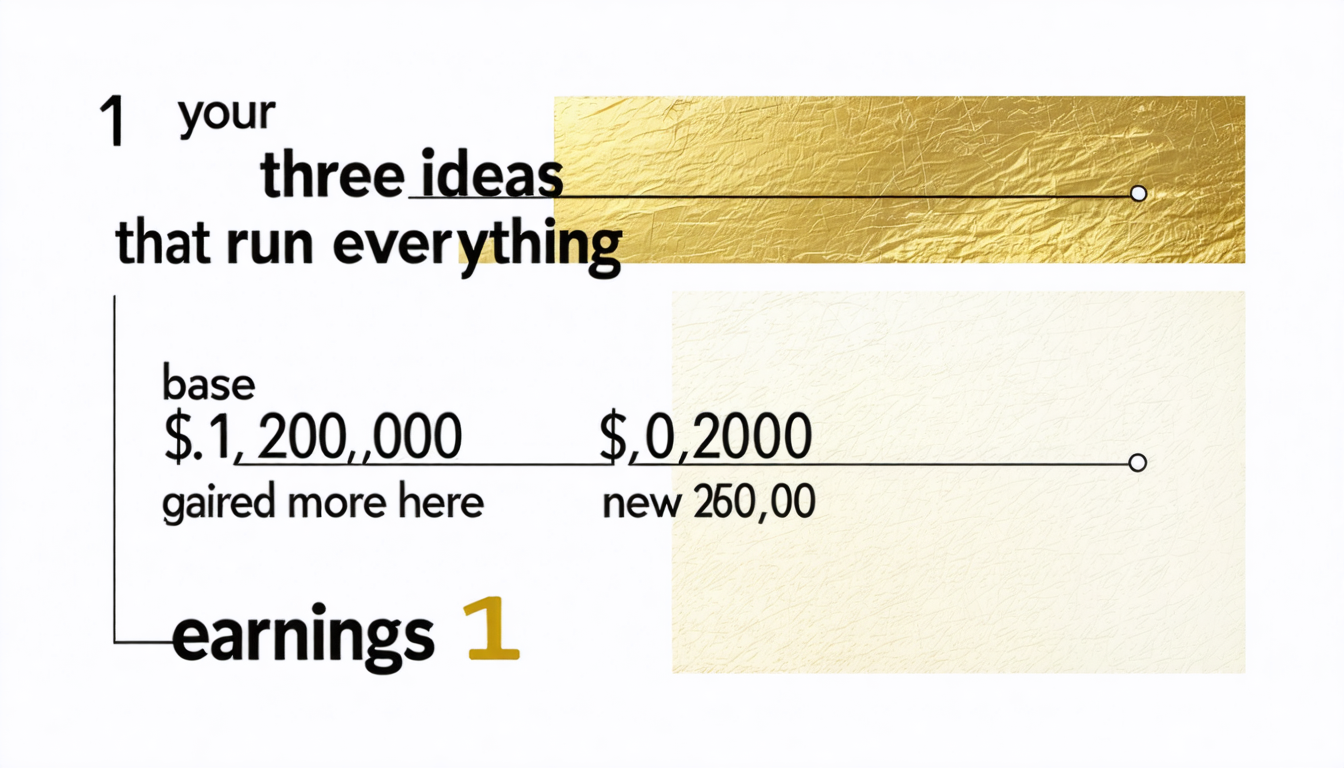
Architecture diagram for Three Ideas That Run Everything. Dark-background gold-on-near-black statement annotation overlay. A mock account statement with three labeled brackets, one per force, in three distinct muted accent colors. Bracket 1 (Compounding) points to the earnings line; callout reads 'Your earnings earned more here' with two rows: BASE $10,000 | EARNED $500 | NEW BASE $10,500 and BASE $10,500 | EARNED $525 | NEW BASE $11,025 — a thick arrow connects the NEW BASE cell of row one to the BASE cell of row two, labeled 'this number moves down.' Bracket 2 (Rising Prices) points to the fixed-amount line; callout reads 'This $1,000 buys like $740 in ten years' with a two-column table: TODAY $1,000 vs IN 10 YEARS $1,000 and a bracket underneath reading 'same number — less buying power.' Bracket 3 (Diversification) points to the fund holdings section; callout reads 'One failure barely moves this' with two side-by-side boxes: ONE COMPANY — $10,000 invested → $0 remaining; FUND OF 500 — $10,000 invested → ~$9,980 remaining. All dollar amounts only, no percentage symbols. Signature dark-field SVG aesthetic, no decorative elements, no faces.
You'll be able to
- Name the three forces that move the balance on any savings statement — compounding, rising prices, and diversification — and give a plain-dollar example of each one
- Explain what 'return' means: the dollars your savings earned this year, figured on the whole pile including last year's earnings
- Describe why a fund of 500 companies protects you in a way that owning one company cannot — and put a dollar figure on the difference
Key concepts · tap to reveal
1/16·Watch·Beat 1 · Hook
0%
Hook
Three invisible forces are moving your savings right now — here is what they are and what they do
Your task Write a prompt that asks Claude to recommend the right AI setup for a real task you're facing — then weigh its answer against this lesson, "Three Ideas That Run Everything."
a strong prompt:role · context · task · format · example
Exercise · scenario
# Scenario — Which Force Is at Work? You are looking at a statement. Three things happened this month: 1. **The balance went up by $500 even though no money was added.** No new deposits. The pile just grew. Which force is at work? Compounding — the earnings that accumulated are now generating their own earnings on top of last year's earnings. The base grew; the earnings grew with it. 2. **A fixed monthly amount is still $1,000, exactly as set two years ago. But the grocery bill is noticeably higher than it was two years ago.** The number on the statement did not change. But what you can buy with it did. Which force is at work? Rising prices — the amount is the same, the buying power is not. 3. **A major retailer you have heard of in the news filed for bankruptcy. A 500-company fund barely moved.** The company failed; the fund kept going. Which force protected the holder? Diversification — the fund holds hundreds of companies, and one failure cannot take the whole basket down.
Deliverable
Take any savings or account statement and a pencil. You are going to label three things. **Step 1 — Label the compounding line.** Find the line that shows what the account earned this period. Write next to it: "Compounding — these earnings will earn more next year because they stay in the pile." **Step 2 — Label the steady-amount line.** Find a fixed number that repeats — a regular contribution, a bill budget, or an income amount. Write next to it: "Rising prices — this number looks steady, but it buys a little less each year." **Step 3 — Label the fund holdings section.** Find the area that lists any fund names.
Practice · Scenarios
0 of 8 revealed
Scenario 1 of 8
You put $10,000 into a fund of 500 companies. One company in the fund goes bankrupt overnight. Roughly how much do you lose?
Sources
- [1]Unknown source·Unknown source (2026) · Vendor
Submit your work for review
Paste your capstone artifact below. You'll get back a 4-level rubric grade, per-criterion feedback, and three concrete edits to strengthen it.