0of16read0 XP
Where You Stand
Run a 30-minute placement conversation that treats 'I don't know' as the most useful routing signal (not a failure), using an opening script that makes a learner feel safe saying they don't understand something
- Time
- 20–25 min
- Type
- exercise
- Bloom
- Apply → Analyze
- XP
- 100
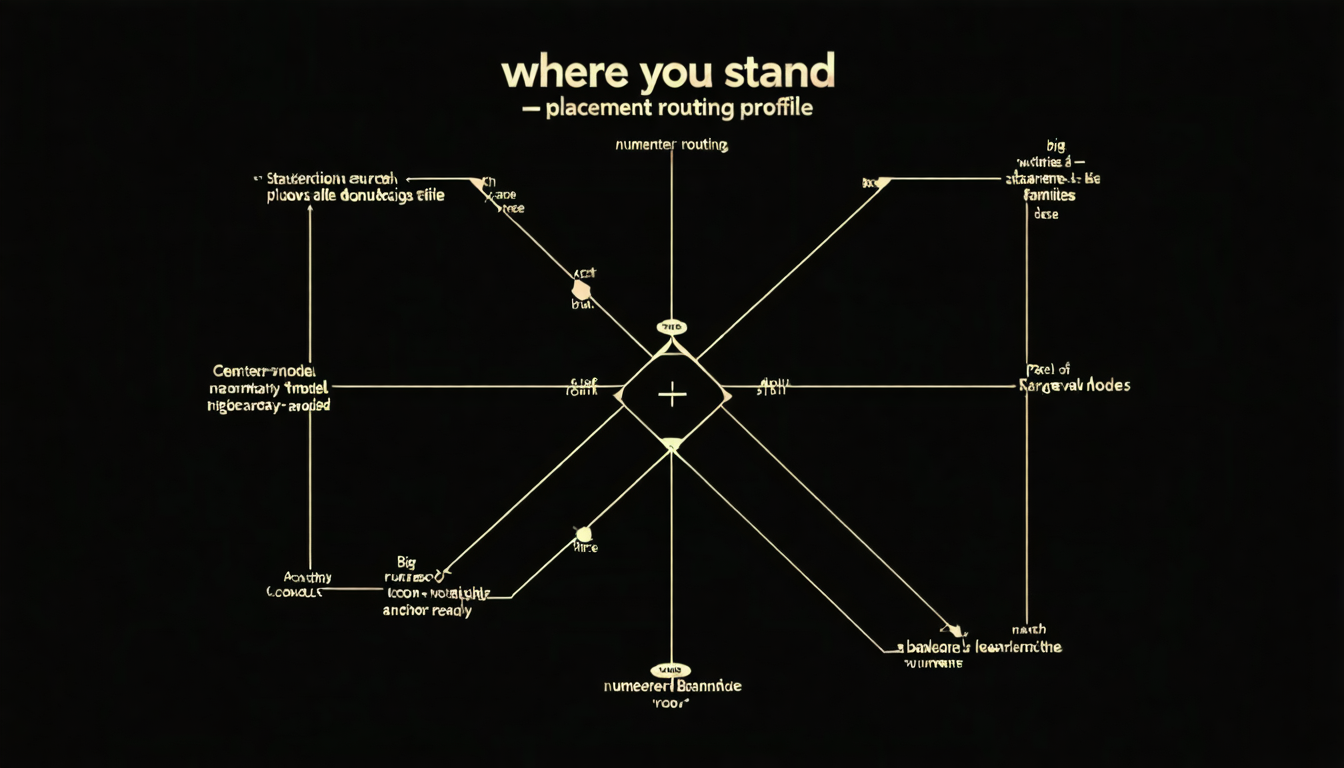
Architecture diagram for Where You Stand. Dark-background routing map on near-black. Gold title at top: 'Where You Stand — Placement Routing Profile.' Center: a branching decision tree with four probe families as labeled input nodes (Statement Anchor, Numeracy, Big Three, Vocabulary & Icon Array, Behavioral Baseline). Each node has two or three outward arrows labeled with routing signals in white text (e.g., 'vault-model,' 'parse-fail,' 'math-ready,' 'guarantee-reading'). Arrows converge on three right-hand destination boxes in gold: 'Branch A — abstract concepts quickly,' 'Branch B — concrete dollars first,' 'Branch C — trust-building first.' A separate small panel in the lower right shows the Behavioral Zero-Point as four fields (check frequency, device, alert awareness, first-call contact) with a gold arrow labeled 'feeds Phase 4 directly.' No percentages anywhere — all examples use dollar figures. A footer note in small white text reads: 'I don't know is valid routing data, not a failure.'
You'll be able to
- Apply a quick self-placement across four core probes — reading a statement, the Big Three (inflation, compounding, diversification), the 1% calculation, and key vocabulary — treating 'I'm not sure' as useful routing data, not failure
- Classify each probe result — vault-model versus market-value thinking, parse-failure versus concept-failure, math-ready versus needs-support — to see which ideas to build first
- Assess your behavioral baseline (how often you check, what device you use, whether you've sold during a downturn, who you'd call first) to anchor the habits you build later
- Use your combined probe profile to choose your starting branch (A, B, or C), knowing every branch is a valid starting point
Key concepts · tap to reveal
1/16·Watch·Beat 1 · Hook
0%
Hook
A learner sits down to figure out where to start. You say: I'm not going to quiz you. I just want to understand where you're starting from.
Your task Write a prompt that asks Claude to recommend the right AI setup for a real task you're facing — then weigh its answer against this lesson, "Where You Stand."
a strong prompt:role · context · task · format · example
Exercise · scenario
# Scenario — Three Moments That Go Wrong Here are three common facilitator mistakes in a placement conversation — and what to do instead. **Moment 1: The learner says 'I don't know' and you feel the urge to help.** You ask what 1% of a $10,000 balance is. They pause for fifteen seconds and say, 'I don't know.' You feel uncomfortable with the silence and say, 'Well, it's just moving the decimal point — so it would be about a hundred dollars.' What went wrong: You just collapsed the most useful data point in the session. Their 'I don't know' was routing signal. Your hint converted it to something that might look like a partial pass on math. Now you don't know if they could do it themselves. Always wait. Write the response. Move on. **Moment 2: The learner gives a wrong answer and you correct it.** You ask what they would think if the balance dropped a few percent. They say, 'I'd call the bank — someone must have taken it.' You say, 'Actually, it just means the market went down — nobody took anything.' What went wrong: You just pre-taught content that Phase 1 is designed to introduce.
Deliverable
Right after the session, fill in the Routing Profile grid. Seven rows, one for each probe family. For each row: 1. Write the learner's exact words in the 'Response' column — not your summary, their words. 2. Circle the routing signal. 3. Circle the branch implication. Then look at the full profile. Most responses will cluster — mostly A, mostly B, or mostly C. If the profile is mixed, the branch is determined by the most restrictive signal. Two concept-fails on the Big Three routes to Branch C even if vocabulary and numeracy passed.
Practice · Scenarios
0 of 8 revealed
Scenario 1 of 8
You ask what the big balance number means to the learner. They say, 'That's my money — it's what I have saved.' You ask what they'd think if it dropped a few percent. They say, 'Someone took it — something went wrong.' What mental model are they working from?
Sources
- [1]Unknown source·Unknown source (2026) · Vendor
Submit your work for review
Paste your capstone artifact below. You'll get back a 4-level rubric grade, per-criterion feedback, and three concrete edits to strengthen it.