0of15read0 XP

What is an AI system, really?
Draw the full boundary of a deployed AI system, the data, the model, the surrounding software, the humans in the loop, and any third-party vendors, instead of pointing at the model and calling that "the system".
- Time
- 20–25 min
- Type
- exercise
- Bloom
- Apply → Create
- XP
- 100
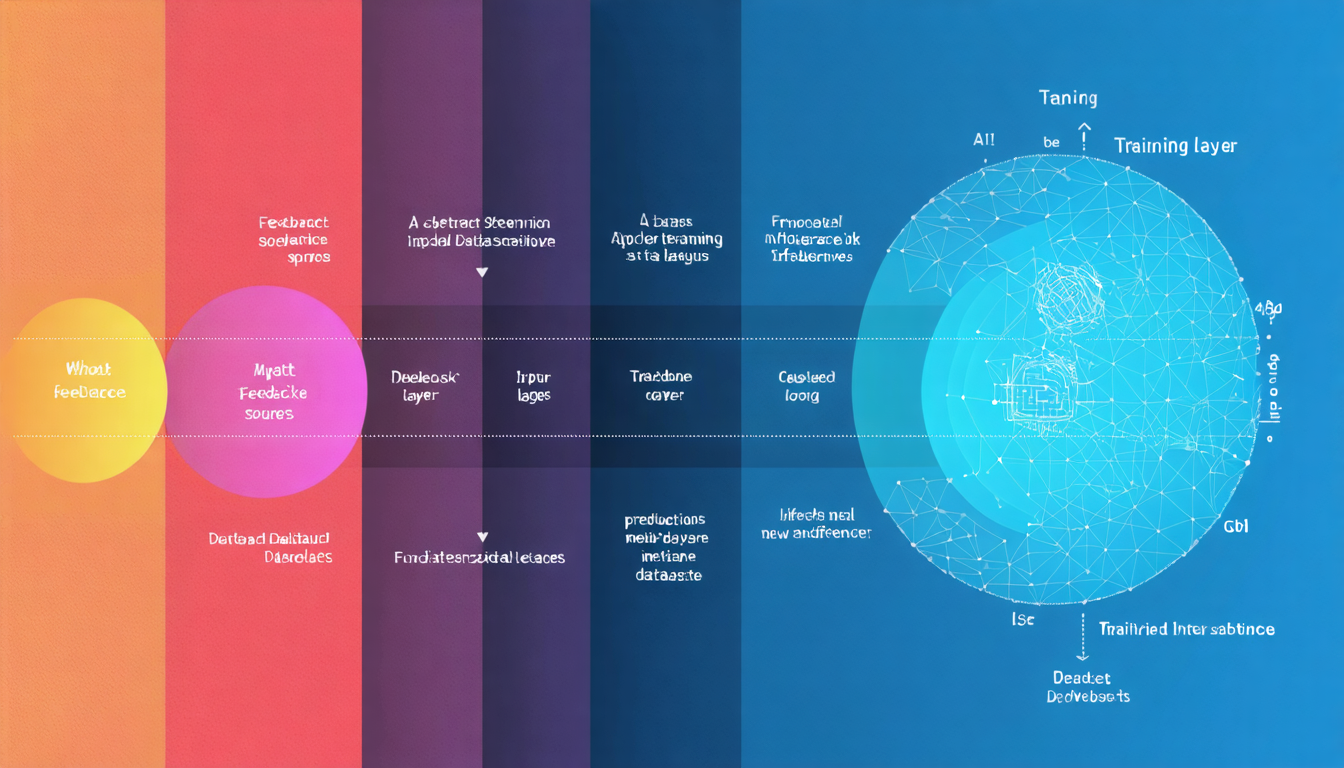
Architecture diagram for What is an AI system, really?. A layered architecture diagram showing an AI system's functional pipeline with four horizontal stages: Input Layer (raw data sources with sensors/databases icons), Training Layer (model learning process with feedback loops and labeled datasets), Inference Layer (deployed model processing new inputs with confidence scores), and Output Layer (predictions/decisions feeding into applications). Contrast this with a parallel simplified pipeline for traditional software showing direct rule-based logic without the training phase. Use blue tones for AI components, gray for traditional software. Include arrows showing data flow direction and a dotted feedback loop from output back to training. Label key distinctions: "learns from data" versus "executes predefined rules" and "probabilistic outputs" versus "deterministic results." Position NIST AI RMF lifecycle phases as annotations along the pipeline stages.
You'll be able to
- Draw the full boundary of a deployed AI system, the data, the model, the surrounding software, the humans in the loop, and any third-party vendors, instead of pointing at the model and calling that "the system".
- Map a real AI system across its life phases, design, development, deployment, and operate-and-monitor, and name who is accountable at each phase.
- Locate where accountability attaches, and where it slips, as a system moves through its lifecycle and across the boundary between your organization and a vendor.
- Check an AI tool's documentation for what an operator actually needs: what the system can and can't do, where humans oversee it, and whether it sets honest expectations about errors.
- Plan how a problem gets reported and handled when the system misbehaves, including what to do when the failing piece belongs to a vendor.
Key concepts · tap to reveal
1/15·Watch·Beat 1 · Hook
0%
Hook
You can own your own AI decisions. But what you are accountable for is bigger than any one prompt, it is a whole system, and the model is only one part of it. A vendor says "94% accuracy." Before you sign, the harder question: what exactly are you buying?
Your task Write a prompt that asks Claude to recommend the right AI setup for a real task you're facing — then weigh its answer against this lesson, "What is an AI system, really?."
a strong prompt:role · context · task · format · example
Exercise · scenario
A regional hospital deploys a new radiology workflow tool. Radiologists upload chest X-rays; the tool highlights regions with pixel-intensity anomalies using fixed threshold rules defined in the configuration file. No historical image data was used to tune these thresholds, they were set by the vendor based on published clinical guidelines. The tool generates a binary flag ("review recommended" or "no anomalies detected") and logs the decision. The hospital's IT director must classify this system for regulatory reporting under emerging AI governance frameworks.
Deliverable
Add a **System Context and Lifecycle Map** page to your running **AI Fluency Playbook**. Pick one real or hypothetical AI system (a pre-trained language model API, an image classifier, a recommendation engine) and map it across the four lifecycle phases, AI Design, AI Development, AI Deployment, and Operation and Monitoring. For each phase, write down which actors are involved (data scientists, domain experts, operators, evaluators), what they do, what the system's knowledge limits are, and how an incident or error would reach the people who need to know.
Reveal model answer
Conventional rule-based software system
Practice · Scenarios
0 of 8 revealed
Scenario 1 of 8
An online store recommends products. Once a month a program studies the entire purchase history and builds a table of which products go together, patterns learned from the data. At checkout the site just looks up your item in the table and shows the top five matches; nothing new is learned in the moment. The CTO must answer an investor questionnaire about whether the company uses AI.
Common misconceptions
“the AI system is the model”
the model is one component; the system is the data, the model, the software, the humans, and the vendors, across a lifecycle, and accountability attaches to that whole, not to the model alone.
Sources
- [1]NIST AI Risk Management Framework 1.0·NIST AI Risk Management Framework 1.0 > Function: MANAGE > Category: MANAGE 3 AI > MANAGE 3.2: Pre-trained models which are used for develop (2025) · Regulation
- [2]OpenAlex API·OpenAlex API > Guidelines for Human-AI Interaction > INTRODUCTION (2025) · Research
Submit your work for review
Paste your capstone artifact below. You'll get back a 4-level rubric grade, per-criterion feedback, and three concrete edits to strengthen it.